Categories
Today

Succession?

President Harry S. Truman signed the Presidential Succession Act on July 18, 1947. Article II, Section 1, Clause 6 of the United States Constitution authorizes Congress to enact such a statute, which Congress has done on three occasions: 1792, 1886, and 1947. The 1947 Act was last revised 59 years after passing, in 2006.

Categories
insider corruption partisanship scandal

The Salience of the Switch

From the moment the Jeffrey Epstein story appeared, an outrageous quality attached itself to it, like slug-slime on the heel of your naked foot.

Now, as the case is allegedly closing, it’s only getting weirder.

It’s needless to run through the arc of the story again: the rumors, the financing, the arrests, the trials, the documentaries, the books and articles, the “suicide.” Most people are aware. And most know that it was MAGA folks who were most exercised about the issue. 

“Epstein didn’t kill himself” was not a meme of the left.

The idea that Mr. Epstein had fronted a honey-pot blackmail ring to exert control over politics and science and culture was a story that even the mainstream didn’t pooh-pooh much, because, in part, there was so much circumstantial evidence.

Then came the switch, when Dan Bongino and Kash Patel assured us that Epstein did indeed commit suicide. When I commented a week ago, it was Trump switching sides — after years milking MAGA anger over it — that stood out. 

And now it got bigger. In two ways. Trump’s switch got bigger. And the evidence for Epstein’s self-offing got shakier.

The latter is explosive evidence that our leaders may have lied to us. And done a lousy job of it.  The taped evidence said to prove that no one had been to visit Epstein in his cell was first shown to have been clumsily edited, and then all-the-sudden more footage came out!

Meanwhile, Trump took to calling the Epstein File issue a “hoax” perpetrated by Democrats — Comey, Obama and Biden specifically!

Do they think we’re stupid?

This is Common Sense. I’m Paul Jacob.


PDF for printing

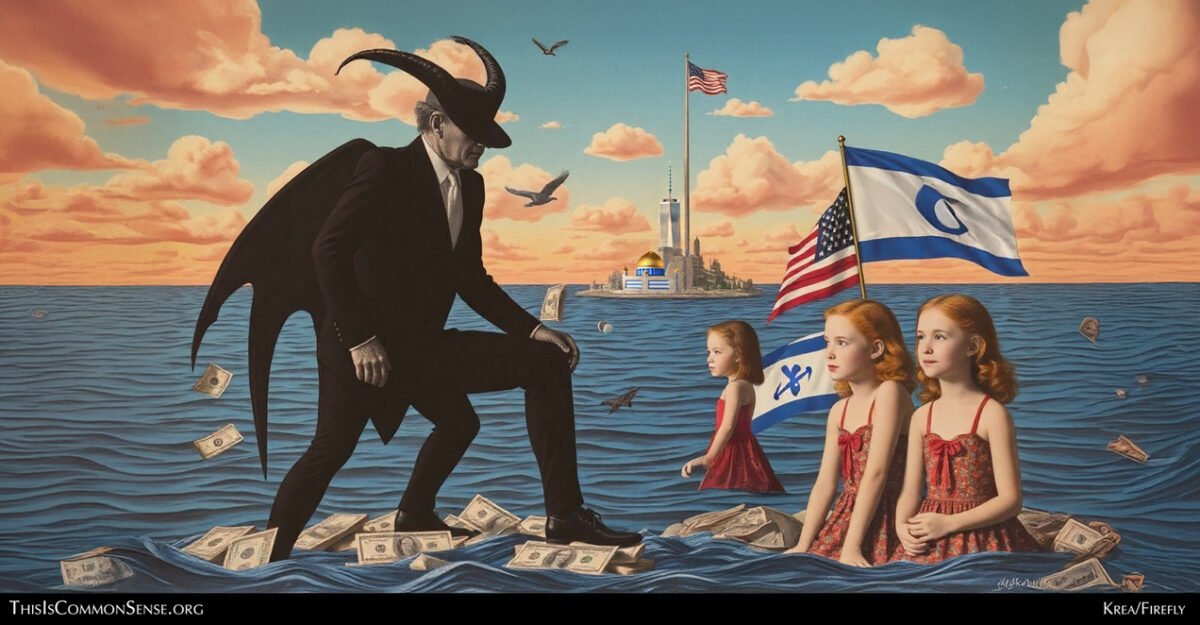
Illustration created with Krea and Firefly

See all recent commentary
(simplified and organized)
See recent popular posts

Categories
Thought

E.B. White

Did it ever occur to you that there’s no limit to how complicated things can get, on account of one thing always leading to another?

E.B. White, “Quo Vadimus?” The Adelphi (January 1930).
Categories
Today

Wrong Way?

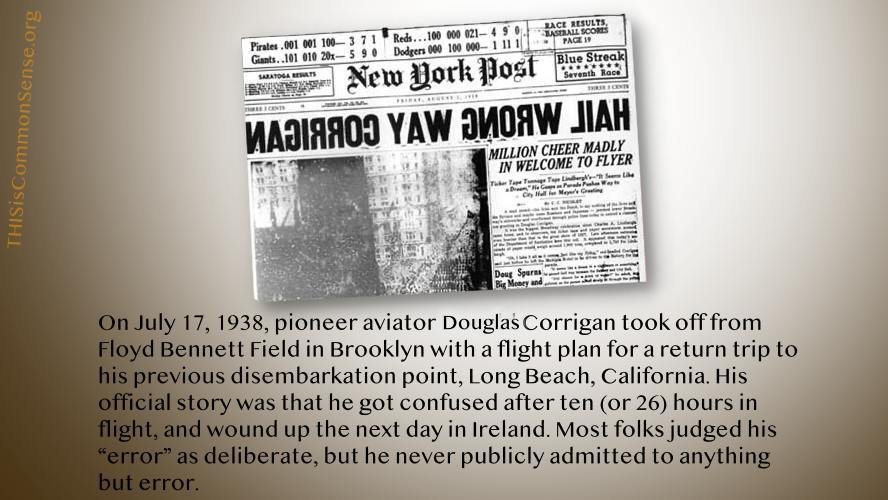
On July 17, 1938, pioneer aviator Douglas Corrigan took off from Floyd Bennett Field in Brooklyn — New York City’s first municipal airport — with a flight plan for a return trip to his previous disembarkation point, Long Beach, California. His official story was that he got confused after ten (or 26) hours in flight, and wound up the next day in Ireland. Most folks judged his “error” as deliberate, but he never publicly admitted to anything but error. He was nicknamed “‘Wrong Way’ Corrigan,” an affectionate moniker, and received a 14-day suspension of his pilot’s license as punishment for his breaking of many, many regulations.

One occasionally hears the epithet “Wrong Way Corrigan” applied to anyone who similarly takes a slight liberty, skirting official rules or practices — or simply goes the wrong direction.


July 17, 1975, had a very different kind of aviation event, one well-planned: Apollo 18 and Soyuz 19 made the first US/USSR linkup in space.

Categories
Accountability national politics & policies scandal

The Autopen Question

When the Heritage Foundation’s Oversight Project offered its report on the Biden Administration’s use of the presidential “autopen,” in March, the legality of many of President Joe Biden’s signatures were placed in jeopardy.

Since then, Republicans in Congress and Trump in the White House have been pushing the case that White House staff often used the autopen sometimes without the presidential awareness.

Since then, Republicans in Congress and President Trump have been pushing the case that White House staff often used the autopen and sometimes without presidential awareness.

If so, with the non-stroke of a non-pen, could much of what came out of 1600 Pennsylvania Avenue for four years be un-done?

“The full picture of what Mr. Biden did on pardon and clemency decisions,” the New York Times explains, “and how much he directed those decisions and the actions of his staff, including the use of the autopen, may come down to tens of thousands of Biden White House emails that the National Archives has turned over as part of the investigation by the Trump White House and the Justice Department.”

Times reporters investigated some of the emails, offering a tentative-if-predictable conclusion: “the Biden White House had a process to establish that Mr. Biden had orally made decisions in meetings before the staff secretary, Stefanie Feldman, who managed use of the autopen, would have clemency records put through the signing device.”

And of course Biden himself defends the integrity of his administration: “Let me be clear: I made the decisions during my presidency.

“I made the decisions about the pardons, executive orders, legislation and proclamations.” 

Trust him!

The Times has been working to encourage us to trust the ex-president. Its March article, “How an Autopen Conspiracy Theory About Biden Went Viral,” clearly shows its bias — a context piece before any real investigation.

This is Common Sense. I’m Paul Jacob.


PDF for printing

Illustration created with Krea and Firefly

See all recent commentary
(simplified and organized)
See recent popular posts
Categories
Thought

Jeremy Bentham

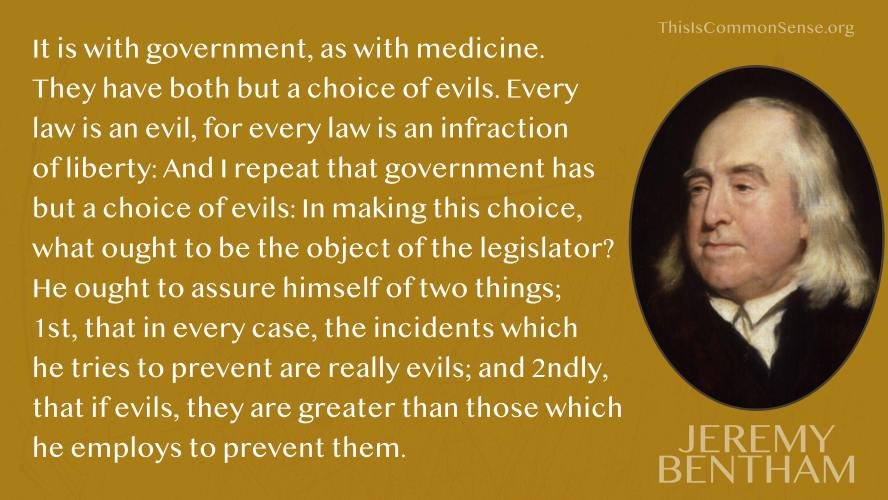
It is with government, as with medicine. They have both but a choice of evils. Every law is an evil, for every law is an infraction of liberty: And I repeat that government has but a choice of evils: In making this choice, what ought to be the object of the legislator? He ought to assure himself of two things; 1st, that in every case, the incidents which he tries to prevent are really evils; and 2ndly, that if evils, they are greater than those which he employs to prevent them.

Jeremy Bentham, Principles of Legislation (1830), Ch. X : “Analysis of Political Good and Evil; How they are spread in society.”
Categories
Today

Ethiopia

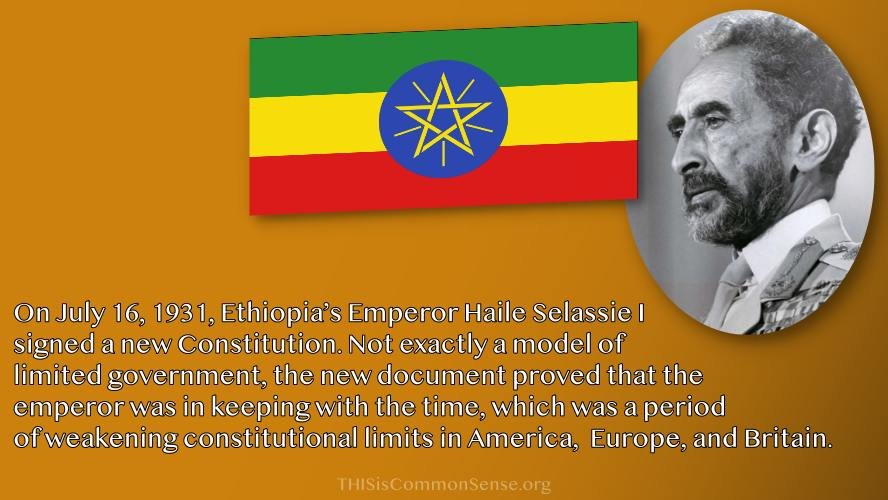
On July 16, 1931, Ethiopia’s Emperor Haile Selassie I signed a new Constitution. Not exactly a model of limited government, the new document proved that the emperor was in keeping with the time, which was a period of weakening constitutional limits in America, Europe, and Britain. A flavor of the document can be gained by its most “rights-oriented” measures:

Art. 22. Within the limits laid down by the law, Ethiopian subjects have the right to pass freely from one place to the other.
Art. 23. No Ethiopian subject may be arrested, sentenced, or imprisoned except in pursuance of the law.
Art. 24. No Ethiopian subject may, against his will, be deprived of his right to be tried by a legally established court.
Art. 25. Except in cases provided for by law, no domiciliary searches may be made.
Art. 26. Except in cases provided by the law, no one shall have the right to violate the secrecy of the correspondence of Ethiopian subjects.
Art. 27. Except in cases of public necessity determined by the law, no one shall have the right to deprive an Ethiopian subject of any movable or landed property which he owns.
Art. 28. All Ethiopian subjects have the right to present to the Government petitions in legal form.
Art. 29. The provisions of the present chapter shall in no way limit the measures which the Emperor, by virtue of his supreme power, may take in the event of war or public misfortunes menacing the interests of the nation.

Categories
ideological culture public opinion

Bad, Worse & Communist

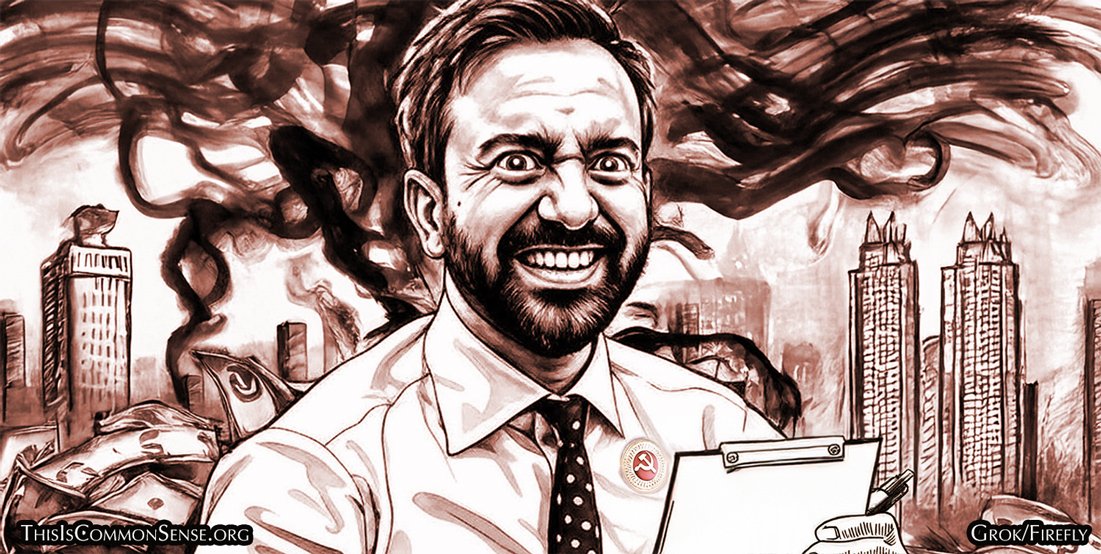
After four recent commentaries showing, without hyperbole, that Democratic Party mayoral nominee Zohran Mamdani is a flat-out seize-the-means-of-production communist, you might wonder why anyone could possibly vote for him. 

Well, elections are a choice. And New Yorkers have a plethora of lousy choices — especially the best-known politicians running against Mamdani. 

Take former Governor Andrew Cuomo — puh-leez! He finished second to Mamdani in last month’s Democratic mayoral primary but has vowed to stay in the race on the ballot line of his recently formed Fight & Deliver Party.

The key reason for Mamdani’s victory? Voter revulsion with Mr. Cuomo. After serving ten years as governor and announcing he would seek a fourth four-year term, Cuomo was rocked by sexual harassment allegations (including “attempts to silence victims”). Facing “almost certain removal from office” by the state legislature, he resigned in 2021. 

“To Mr. Cuomo, I have never had to resign in disgrace,” responded Mamdani to Cuomo in a televised debate. “I have never cut Medicaid. I have never stolen hundreds of millions of dollars from the MTA [Metropolitan Transportation Authority]. I have never hounded the 13 women who credibly accused me of sexual harassment. I have never sued for their gynecological records. And I have never done those things because I am not you, Mr. Cuomo.” 

Mamdani’s other major opponent is the incumbent, Mayor Eric Adams, who was indicted last year on five felony counts, including conspiracy to receive campaign contributions from foreign nationals, soliciting and accepting a bribe, and wire fraud. Though Trump’s Department of Justice dropped the prosecution, or maybe partly because of that, Adams is a pariah among the city’s supermajority of Democratic voters.

The problem is staring us in the face: When the choice is between communism and corruption, communism stands a better chance.

This is Common Sense. I’m Paul Jacob.


PDF for printing

Illustration created with Grok and Firefly

See all recent commentary
(simplified and organized)
See recent popular posts
Categories
Thought

E.B. White

I am a member of a party of one, and I live in an age of fear. Nothing lately has unsettled my party and raised my fears so much as your editorial, on Thanksgiving Day, suggesting that employees should be required to state their beliefs in order to hold their jobs. The idea is inconsistent with our constitutional theory and has been stubbornly opposed by watchful men since the early days of the Republic.

E.B. White, letter to the New York Herald Tribune (November 29, 1947).
Categories
Today

“Malaise”

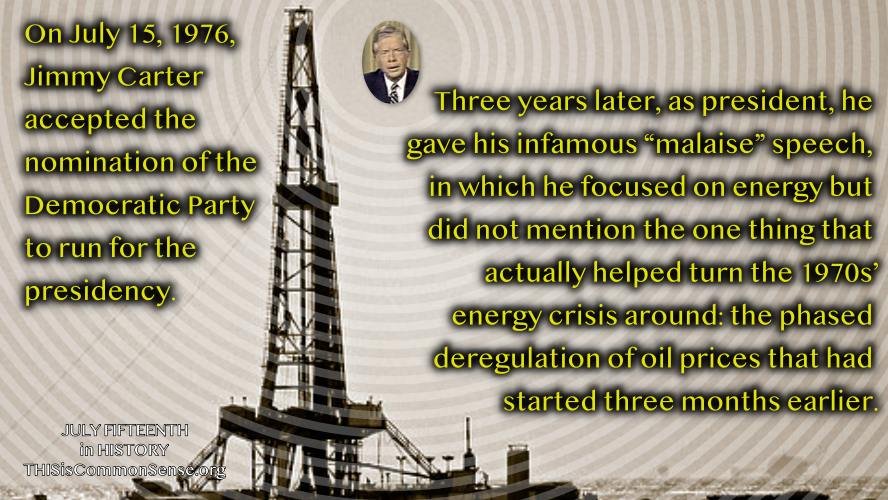
On July 15, 1976, Jimmy Carter accepted the nomination of the Democratic Party to run for the presidency.

Three years later, as president, he gave his infamous “malaise” speech, in which he focused on energy but did not mention the one thing that actually helped turn the 1970s’ energy crisis around: the phased deregulation of oil prices that had started three months earlier, under his own directive. Instead of touting this deregulatory effort, Carter did the politic thing, promising a number of new government programs while extensively grinding a “crisis of confidence” message and vaguely speaking of a spiritual challenge.

The deregulation was startlingly effective, in the long run — though the immediate effect was a rocketing of prices. These high prices presented profit opportunities, and (lo and behold!) domestic production greatly increased, allowing for many, many years of lower prices. Those high prices would have worked better as market signals had not Carter and Congress also established “windfall profits” taxes, to take away those temporary gains to existing business.

Had Carter deregulated prices earlier, he would probably have been re-elected president. Had he emphasized deregulation, he probably would have beat back Ronald Reagan’s free market rhetoric — with actual action.

The price controls had been put in place earlier in the decade by the Republican president at the time, Richard M. Nixon, with the great help of his aides Dick Cheney and Donald Rumsfeld.