On November 14, 1918, Czechoslovakia became a republic.
Born on the same date 29 years later, American writer P. J. O’Rourke.

On November 14, 1918, Czechoslovakia became a republic.
Born on the same date 29 years later, American writer P. J. O’Rourke.

A federal judge has ruled that the National Rifle Association has a plausible case against New York Governor Andrew Cuomo; the NRA’s lawsuit, alleging that the organization’s rights have been violated by the governor, is going ahead.
As related by Jacob Sullum in two pieces over at Reason, Cuomo sure looks guilty.
Indeed, the governor’s own words convict him: “If the @NRA goes bankrupt because of the State of New York, they’ll be in my thoughts and prayers. I’ll see you in court.”
Precisely.
What has Cuomo done? “I am directing the Department of Financial Services,” he commanded, “to urge insurers and bankers statewide to determine whether any relationship they may have with the NRA or similar organizations sends the wrong message to their clients and their communities.”
Is this just regulatory business as usual, as defenders of Cuomo harrumph? Or is it a real violation of rights?
It can be both.
This is more than “bully pulpit” power, it is actual, gun-under-the-table power — the kind you give to regulators when you set up regulatory bodies rather than establish general principles under a rule of law.
It is a problem on every level of our society, especially the federal government. But states like New York are obviously not immune.
And it reminds me of Mussolini’s method, of The Leader taking control and bullying businesses and groups to do his bidding. (For the “public safety” and to “end violence” — of course.) The essence of fascism.
It’s good to see Il Duce Cuomo get some legal pushback.
In this Land of the Allegedly Free.
This is Common Sense. I’m Paul Jacob.


November 13 is World Kindness Day, which has been celebrated in various countries since 1998. It is not an official celebratory day of the U.S.A., or of the United Nations. But individuals are free to be kind this day . . . or any day, for that matter.
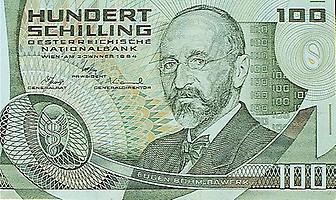
The monopolist . . . never has unlimited control; he merely has the choice within the laws of price of different “economically possible” price levels. He can select that price at which the combination of profit for each article, and the number of articles to be sold at that price, are likely to promise the greatest total profit, but he cannot exert his “power” in any other way than in conformity with the laws of price, for it is his behavior that establishes the “price law,” namely the conditions of the amount offered at a given price level, but never can he counteract the laws of price.
Eugen von Böhm-Bawerk, “Control or Economic Law,” Zeitschrift für Volkswirtshaft, Sozialpolitik und Verwaltung, Volume XXIII (1914): 205–71; John Richard Mez, Ph.D., translator.

Arkansas politicians and their cronies were terrified by Issue 3. So when this tough state legislative term limits measure was approved for the ballot, foes of citizen-controlled government sued to kill it.
Agreeing that thousands of already-approved signatures of bonafide registered voters must be tossed because of new, legislatively-imposed, byzantine, legal technicalities, the Arkansas Supreme Court ruled that the measure was unsuited for ballot. Yet it was too late to pull it.
The vote simply wouldn’t count, that’s all.
So, why was Issue 3 proposed?
A few years earlier, in 2014, lawmakers had posted a deceptive ballot question consisting of a laundry list of “ethics reforms.” Carefully obscured in the measure was a massive increase in legislative tenure. Sadly, the scam succeeded and voters passed the measure, which allows legislators now to serve up to 16 years (or more) in one seat.
To fix this, Issue 3 sought to impose a maximum of three two-year terms in the house, two four-year terms in the senate, and ten years on overall legislative service. It would also have prohibited lawmakers from sending future term limits measures to the ballot.
After November 6, votes on Issue 3 did get reported in at least some counties. Max Brantley of the Arkansas Times notes that in Pulaski, Washington, and Pope Counties, the Yes vote for 3 exceeds 75 percent. I’m sure these counties are representative.
“I think the term limits crowd should try again,” Brantley says, “if the state motto is to be Regnat Populus rather than Regnat Lobbyist.”
Agreed.
Let the people rule.
This is Common Sense. I’m Paul Jacob.

On November 12, 1905, Norwegians established, by referendum, a monarchy — not a republic. Exactly 14 years later, to the day, Austria became a republic.
There is a heartfelt and near-universal refusal to understand the basic economic principles behind the creation of wealth.
P. J. O’Rourke, Eat the Rich: A Treatise on Economics (1998), p. 235.
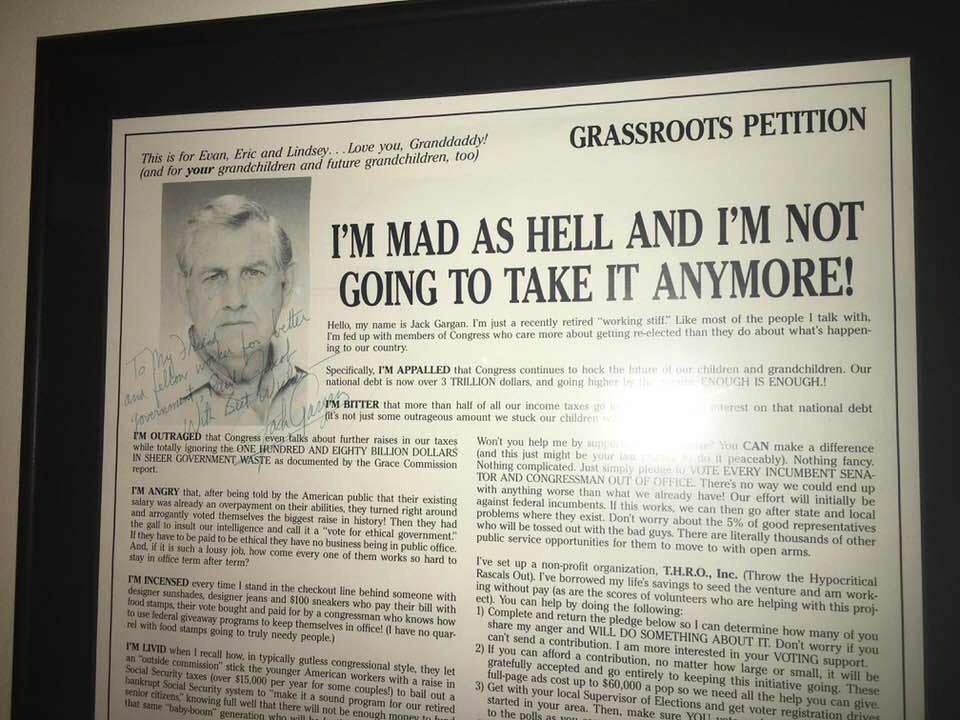
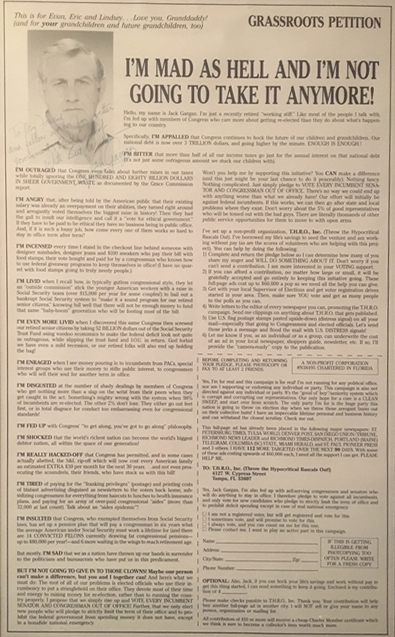
We noted the passing of Jack Gargan on Wednesday. But if any man is worth two obits, it’s Jack. Click on over to Townhall, then back here for more Jack Appreciation.
This column will appear on this site on Tuesday.
On November 11, 1889, the State of Washington was admitted as the 42nd State of the United States.
In 1918, German officials signed an armistice agreement with the Allies in a railroad car in the forest of Compiègne, France. The fighting officially ended at 11:00 a.m. — the eleventh hour of the eleventh day of the eleventh month. The war officially ended with the signing of the Treaty of Versailles on June 28, 1919.
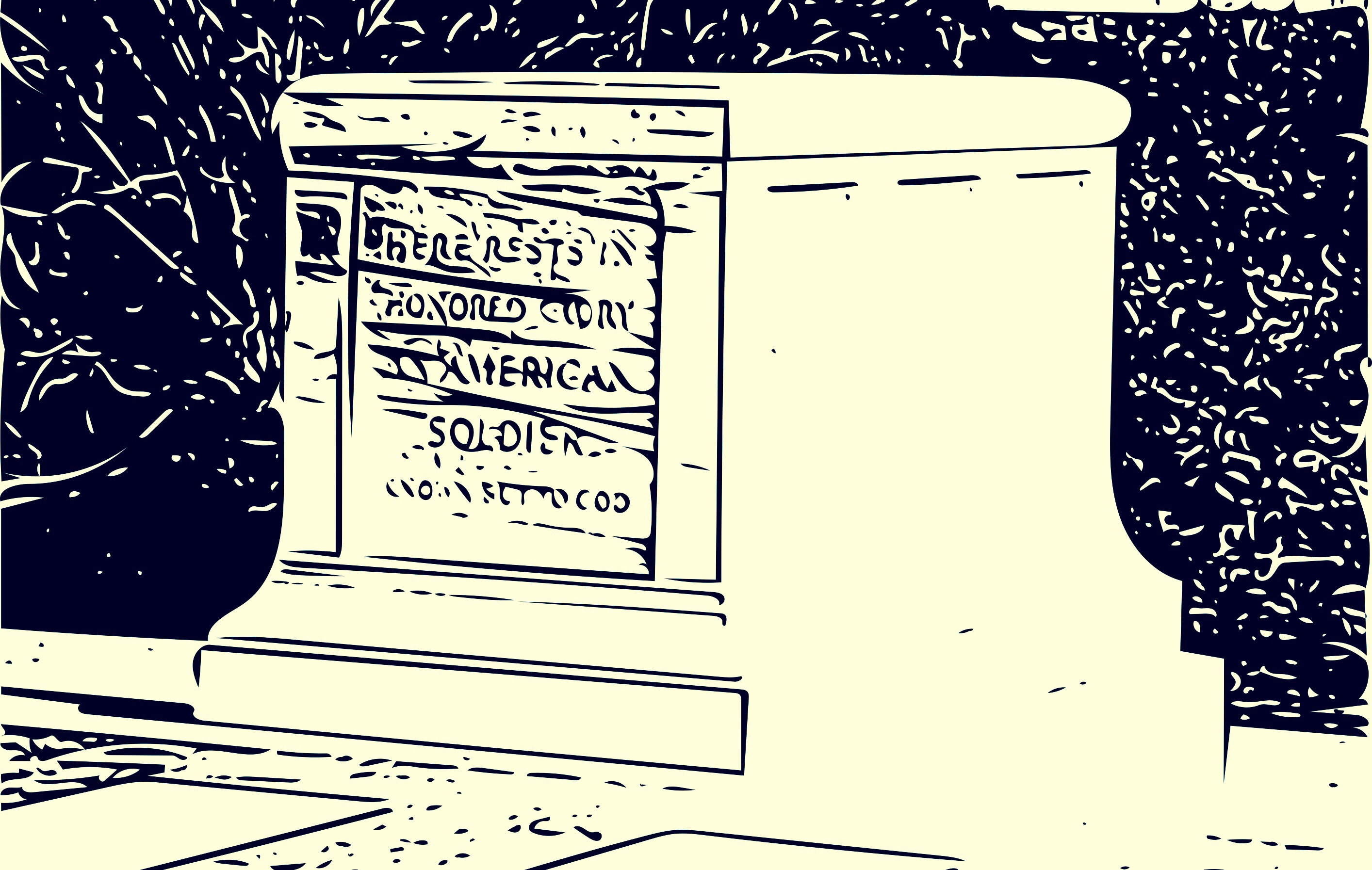
In 1921 on this date, U.S. President Warren G. Harding dedicated the Tomb of the Unknowns at Arlington National Cemetery.
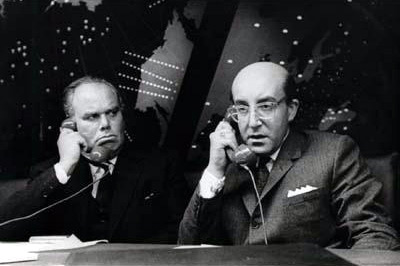
Gentlemen, you can’t fight in here! This is the War Room.
U.S. President Merkin Muffley, as performed by actor Peter Sellers in the (fictional) black comedy Dr. Strangelove, or: How I Stopped Worrying and Learned to Love the Bomb (1964), a film directed by Stanley Kubrick and written by Kubrick, Terry Southern, and Peter George, based on the book Red Alert by Peter George, first published in the UK in 1958 as Two Hours to Doom under the pseudonym Peter Bryant.