The grand, leading principle . . . is the absolute and essential importance of human development in its richest diversity; but national education, since at least it presupposes the selection and appointment of some one instructor, must always promote a definite form of development, however careful to avoid such an error. And hence it is attended with all those disadvantages which we before observed to flow from such a positive policy; and it only remains to be added, that every restriction becomes more directly fatal, when it operates on the moral part of our nature,—that if there is one thing more than another which absolutely requires free activity on the part of the individual, it is precisely education, whose object it is to develop the individual.
Wilhelm von Humboldt, Ideen zu einem Versuch die Grenzen der Wirksamkeit des Staats zu bestimmen (1792; 1852, posthumous), English edition The Sphere and Duties of Government, as translated by Joseph Coulthard (1854). The book also appears in English as The Limits of State Action.
Is there a good, presumptive reason to believe what the government tells us?
Not when it comes from the “intelligence” agencies.
One of the more breathtaking developments of recent years has been the transformation of Democratic Party politicians and activists from skeptics of alphabet soup intelligence agencies — CIA, NSA, FBI and many more — to becoming enthusiastic cheerleaders.
On the bright side, Republicans are drifting in the other direction, from their old-fashioned lockstep support of “intelligence agencies” to a new realism — the relentless Deep State “coup” attempts against the Trump Administration having proved . . . instructive.
While we might wish to think that, whew!, these agencies are comprised of loyal Americans, consider what Senator Chuck Schumer said earlier this year, almost approvingly: “You take on the intelligence community — they have six ways from Sunday at getting back at you.”
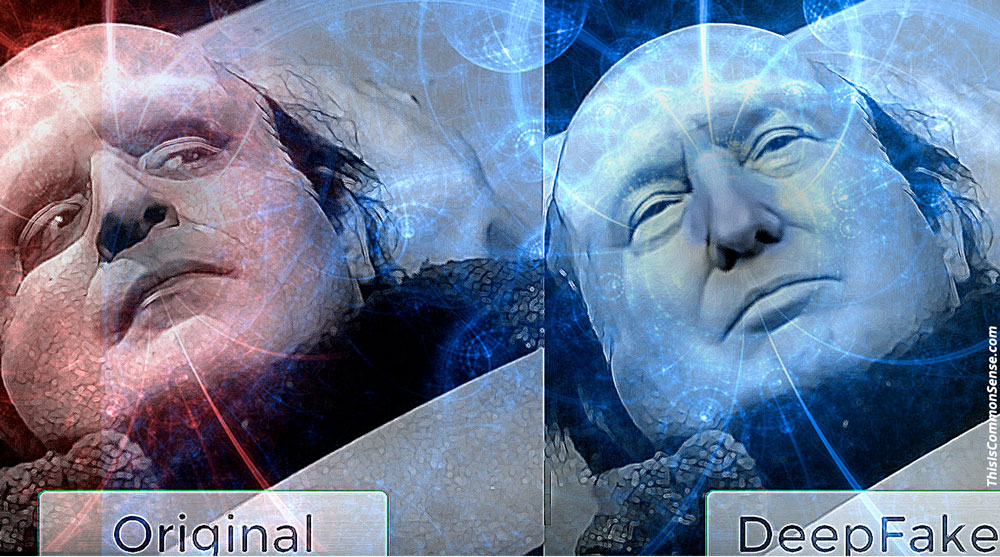
But more important than all this is the developing techniques the Deep State can marshal. I refer to Deepfake tech, where anything video can be faked, convincingly and completely. If not now, then very soon, technicians within the Deep State — and outside, too — will be able to videofake anything, from Trump cavorting with Moscow hookers to an Iranian “attack” to . . . UFO landings.
We shouldn’t have trusted intelligence agencies in the run-up to the Iraq conquest, now we have good reason to doubt anything and everything they tell us.
Which means Congress should take very tight control of them, rein these agencies in — for Congress is indeed worried about deepfake tech.
How?
Well, de-classifying old secrets might be a good start. The last bit of the JFK assassination files? Maybe. UFOs? Maybe. But it’s what’s not on our radar that may be the most important.
On October 2, 1789, George Washington sent the proposed Constitutional amendments (the United States’ Constitution’s Bill of Rights) to the States for ratification.
On the same date in 1919, U.S. President Woodrow Wilson suffered a massive stroke, leaving him partially paralyzed, preventing him from reacting to the economic downturn following the Great War in a Progressive fashion, making his response de facto laissez faire. One insider, and skeptic of Progressive hubris, cattily referred to Wilson’s incapacitation as “a stroke of luck.”
His successor in office, President Warren G. Harding, would go on to massively cut spending as well as taxes, and take on regulation as well. He also released Woodrow Wilson’s domestic war prisoners — ranging from journalists, ordinary folk to socialist presidential candidate Eugene V. Debs — who had dissented from Wilson’s involvement in the war.
The Depression of the early 1920s, though as deep as the early 1930s’, proved remarkably brief, thanks to Harding . . . and Wilson’s “stroke of luck.”
Politicians are all over the vaping issue, like packrats on pet food.
The House Oversight and Reform Subcommittee on Economic and Consumer Policy, C-SPAN explains, held a hearing on the relationship between e-cigarettes and an outbreak in lung disease. Government experts spoke. There was only one empaneled pro-vaping witness, Vicki Porter, who said that vaping was “a health miracle to me,” since it got her off of smoking tobacco.
Rep. Debbie Wasserman-Shultz (D–Fla.) insisted that the record show that she was not to be trusted, since she merely expressed her own opinion as to the superiority of vaping over smoking, noting that Ms. Porter “is not a public health expert.”
But it was Rep. Rashida Tlaib (D–Mich.) who really came out swinging for the interventionist government. Her main concern, writes Robby Soave at Reason, appeared to be Porter’s direct challenging of “the tortured logic of the Oversight and Reform Subcommittee hearing.”
Rep. Tlaib said she “wanted to know more about you,” to Ms. Porter. “You call yourself a ‘converted conservative,’” Tlaib stuttered, “and a reformed Marxist.
“Are you a conspiracy theorist?”
Wh-what?
Ms. Porter answered reasonably. Then Tlaib questioned her regarding why she had winked at one of her colleagues. Porter said they knew each other.
In the 1960s, the CIA pushed the phrase “conspiracy theorist” as a way to publicly marginalize anyone who questioned official pronouncements on the JFK assassinations and even trickier subjects, like UFOs. Rep. Tlaib is either one of those who bought into the CIA line, or is part of some less-than-transparent agenda.
So, are you a conspiracy theorist?
My answer might have been, not until right about now.
On October 1, 1908, Ford produced the first Model T at a plant in Detroit. The auto could travel 40 miles per hour and ran on gasoline or hemp-based fuel. (As oil prices fell, Ford phased out the hemp option.) The Model T was the first car designed for a mass market, rather than as a luxury item. By 1927, Ford had built 15 million Model T cars – the longest production run of any car model until the Volkswagen Beetle surpassed it in 1972.
On October 1, 1918, Lawrence of Arabia (T.E. Lawrence) helped lead a combined Arab and British force that captured Damascus from the Turks during World War I.
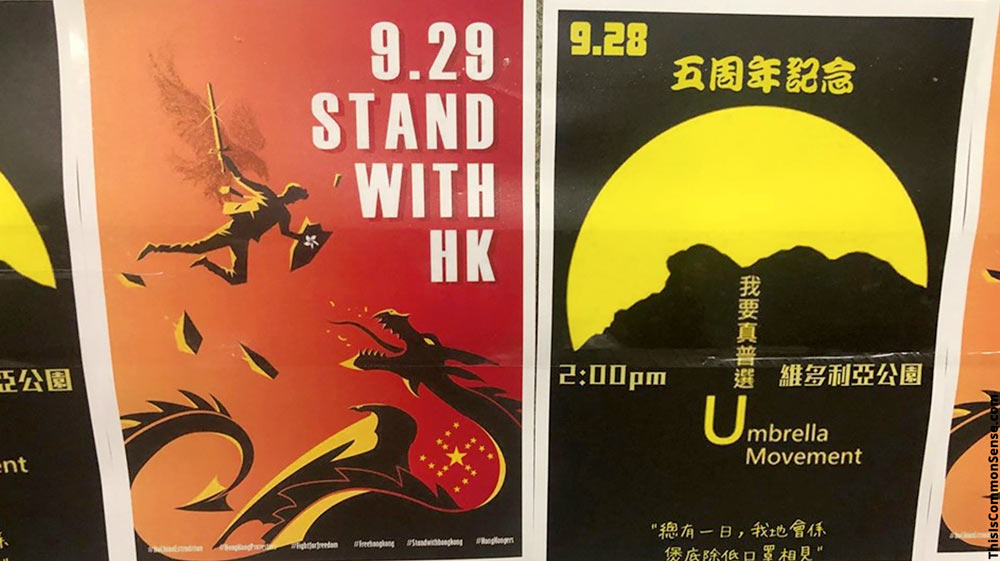
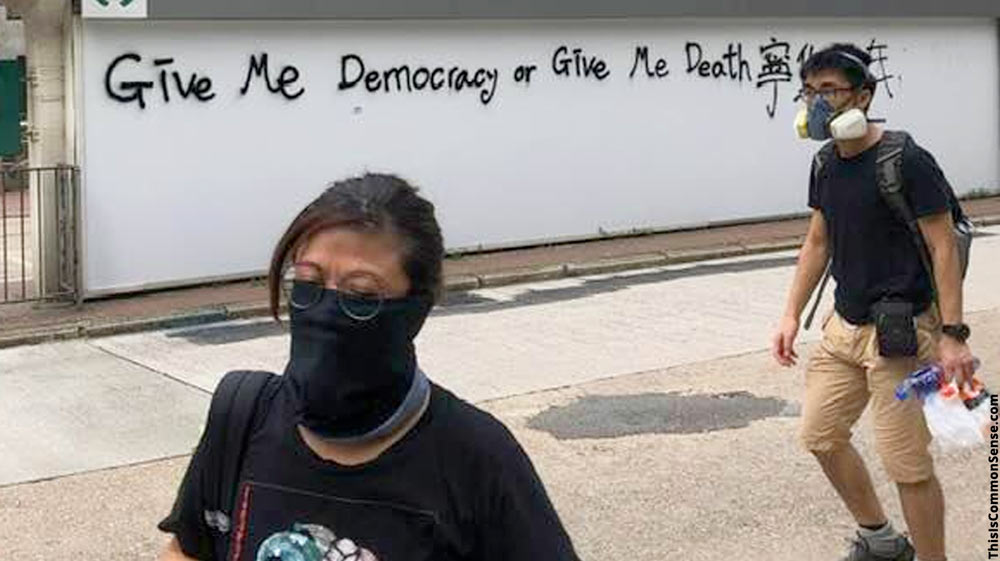
Minding my own business — well, maybe not so much . . . except that “mankind is my business” — I joined Hong Kong’s Global Anti-Totalitarianism Rally.
Is there a more important cause than preventing totalitarian regimes from crushing more lives?
Arriving at the city government complex, I discovered that protesters were marching from another location and would not be there for another 30 minutes or so.
“Hey, I have a plane to catch!” I thought to myself.
Protests are not always punctual.
A convoy of police buses left, leaving press people speculating on whether they were headed to block protesters from getting to the government center at all. Thankfully, about an hour later I saw marchers a block away passing city hall and headed . . . well, to be honest, I had no idea where they were headed. But I hustled up to join their ranks, nonetheless.
After walking for more than half an hour to chants of “Fight for freedom/Stand with Hong Kong,” and “Five demands/Not one less,” I realized had I better get back to the hotel, grab my bags and scoot to the airport.
So I turned around and walked past the long line of marchers, finally reaching city hall where police were set up in riot gear. A small number of protesters were there as well. Suddenly, a policeman fired a volley of tear gas. (I guess such things always seem sudden to those in their sights.) It was followed by several more rounds, which hit both in front of me and behind me.
I saw no cause for the escalation.
“Uh-oh, this is a lot of tear gas,” I realized, holding my breath as I attempted to run outside the range of the rapidly spreading gas. No surprise, but tear gas really burns your eyes — and lungs, too, making it difficult to breathe.
Now it really hit home just how right-on my Friday commentary was to laud Alex Ko, the Taiwanese fellow who raised money to send 2,000 gas mask kits to HK protesters.
As I exited the cloud of smoke, a young man wearing a gas mask came up to me and told me, “Breathe.” It was sound advice.
I was carrying a bottle of water and poured it into both eyes soaking my “Got Liberty?” t-shirt. Which helped a great deal. (I mean the water, not the shirt.)
Another protester handed me a pre-packaged vial of sterilized water. Yet another gave me something labeled “Disposable Surgical Earloop Face Mask.” Neither was effective, frankly, but I certainly appreciated their concern. (And I kept the items as souvenirs.)
Getting back to the hotel was not so simple, either. The subway stations in the surrounding area had been closed by police. And there was a dearth of available taxis. After walking for ten minutes or so, I finally found one and left.
I made my flight, barely, jetting to the greater freedom of Taiwan, and to the Global Forum on Modern Direct Democracy where I’m speaking later this week.
Some wonder why I would take this risk. Well, if these brave young people can continually take much larger risks to fight tyranny, I feel compelled to take much smaller risks to support them. I’m honored to have been with them, to stand with them. Even to cough and gasp and tear up with them.
Those are the tears of future freedom . . . I certainly hope.
A state too expensive in itself, or by virtue of its dependencies, ultimately falls into decay; its free government is transformed into a tyranny; it disregards the principles which it should preserve, and finally degenerates into despotism. The distinguishing characteristic of small republics is stability: the character of large republics is mutability.