And the simple step of a simple courageous man is not to partake in falsehood, not to support false actions!
Aleksandr Solzhenitsyn, Nobel lecture (1970).
Categories
Aleksandr Solzhenitsyn
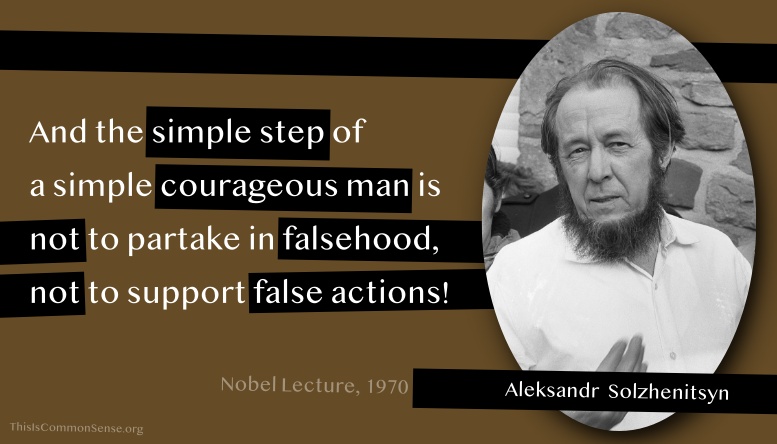
And the simple step of a simple courageous man is not to partake in falsehood, not to support false actions!
Aleksandr Solzhenitsyn, Nobel lecture (1970).
On July 19, 1848, a two-day Women’s Rights Convention opened in Seneca Falls, New York.

Having just finished wringing out a soaked handkerchief, soggy with tears of gratitude for your recent act of high nobility and raw courage in defying the worst aspects of current U.S. policy and your own dismal and dismaying track record of silly pronouncements as Special Presidential Envoy for Climate, an actual title I might add, I wanted to take a moment to say Thank You.
Thank you, sir, thanks for declining to again deploy your eloquence, charisma, and illogic in the service of the same old dreary nonsense.
For when asked during a recent congressional hearing whether the United States would be contributing to a fund to pay “climate reparations” to countries harmed by extreme manifestations of weather, aka “climate-driven” natural disasters, you said, flatly, “No, under no circumstances.”
Wha . . . ? Was this the same man who likened the fight against “climate change” to the fight against the Nazis in World War II?
I mean, I’ll believe it when I don’t see it, but for now I just want to say: Wow!
Especially since last year’s Conference of the Parties, COP27, billed as “a defining moment in the fight against climate change,” where the United States did express support for such payments.
So the U.S. will not, after all, be using taxpayer money to appease other countries for also experiencing weather. Great news. For every minute it lasts, I really appreciate it.
I am veritably dripping with . . . gratitude.
This is Common Sense. I’m Paul Jacob.
Illustration created with PicFinder.ai
See all recent commentary
(simplified and organized)
See recent popular posts
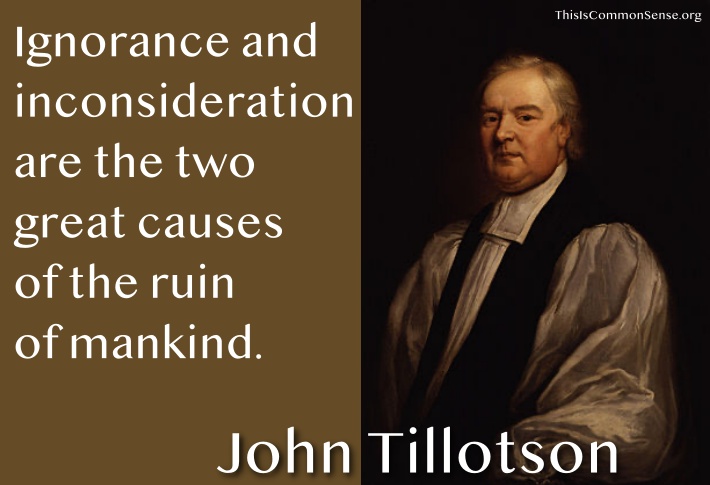
Ignorance and inconsideration are the two great causes of the ruin of mankind.
John Tillotson (1630 – 1694), as quoted in John Adams, A Dissertation on the Canon and Feudal Law (1765).

Echoes of political events past:
Second Declaration of Independence, Or Grand Loco Foco Federal Glorification! To Come Off at the Court House, in the Village of Syracuse, on Saturday, the 18th Day of July, A.D. 1840.
A “Loco Foco” event in New York, five years after an advertisement for a new form of matchstick, the “Loco Foco” (see image above).

Well, the country’s reproduction rate has fallen dramatically, with the demographics heading into a tailspin. This is what decadence really means. So maybe, just maybe, the government should look into it.
But does Spain really need Teresa Ribera?
She’s the minister in charge of MITECO, the department in question. She hit international notoriety last week when video of her riding a bicycle to an EU “climate summit” proved to be something other than a valiant commitment to climate-crisis austerity.
While she intended her cycling to hit the news cycle, how it hit proved . . . hilarious.
She had arrived at the summit via jet — and not a commercial airliner — and then was transported by limo to a spot a hundred meters from the event, stopping to get on her bicycle and pedaling the last bit.
For the show.
Why she thought she’d get away with what Pete Buttigieg had failed at in 2021, as The Daily Wire noted, I don’t know. Maybe our leaders think we’re that stupid. Or perhaps they haven’t completely transitioned to the Age of the iPhone and Internet Challenge.
We must wonder: Do our leaders really believe their own climate prophecies?
They don’t seem to, any more than they believed, in the thick of the pandemic, that masking up and social distancing was something that they, too, should do.
That could be one take-away. But another is that they do, but they know that climate austerity, like the lockdowns, make sense only if most people comply. They are not “most people.” They are special.
For them, the elites, austerity is just a show.
To set us up to suffer — for real.
This is Common Sense. I’m Paul Jacob.
Illustration created with PicFinder.ai
See all recent commentary
(simplified and organized)
See recent popular posts

Be not intimidated, therefore, by any terrors, from publishing with the utmost freedom, whatever can be warranted by the laws of your country; nor suffer yourselves to be wheedled out of your liberties by any pretenses of politeness, delicacy, or decency. These, as they are often used, are but three different names for hypocrisy, chicanery, and cowardice.
John Adams, A Dissertation on the Canon and Feudal Law (1765).
This passage was used as an epigraph by John Abramson in his book Sickening: How Big Pharma Broke American Health Care and How We Can Repair It (2022).

It is a beleaguered world. And this was a podcast fraught with technical problems, yet it turned out pretty good. So maybe there is, generally, hope?
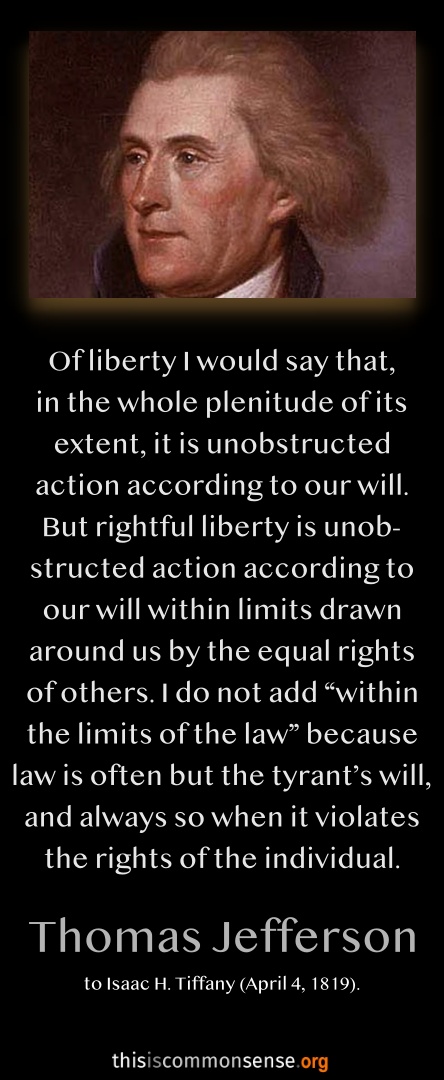
Of liberty I would say that, in the whole plenitude of its extent, it is unobstructed action according to our will. But rightful liberty is unobstructed action according to our will within limits drawn around us by the equal rights of others. I do not add “within the limits of the law” because law is often but the tyrant’s will, and always so when it violates the rights of the individual.
Thomas Jefferson, letter to Isaac H. Tiffany (April 4, 1819).

On July 16, 1931, Ethiopia’s Emperor Haille Selassie I signed a new Constitution. Not exactly a model of limited government, the new document proved that the emperor was in keeping with the time, which was a period of weakening constitutional limits in America, Europe, and Britain. A flavor of the document can be gained by its most “rights-oriented” measures:
Art. 22. Within the limits laid down by the law, Ethiopian subjects have the right to pass freely from one place to the other.
Art. 23. No Ethiopian subject may be arrested, sentenced, or imprisoned except in pursuance of the law.
Art. 24. No Ethiopian subject may, against his will, be deprived of his right to be tried by a legally established court.
Art. 25. Except in cases provided for by law, no domiciliary searches may be made.
Art. 26. Except in cases provided by the law, no one shall have the right to violate the secrecy of the correspondence of Ethiopian subjects.
Art. 27. Except in cases of public necessity determined by the law, no one shall have the right to deprive an Ethiopian subject of any movable or landed property which he owns.
Art. 28. All Ethiopian subjects have the right to present to the Government petitions in legal form.
Art. 29. The provisions of the present chapter shall in no way limit the measures which the Emperor, by virtue of his supreme power, may take in the event of war or public misfortunes menacing the interests of the nation.