Categories
Accountability crime and punishment national politics & policies

The Slope of Service

“Heads should roll at Secret Service,” I declared on Monday.

That was before I stumbled upon Secret Service Director Kimberly Cheatle explaining to ABC News the strategic situational thinking employed by the agency in determining not to place agents on top of the roof of a building where the assassin fired multiple rounds, hitting former President Trump in the ear, killing a man attending the rally with his family and seriously wounding two others. 

Director Cheatle offered that “the Secret Service was aware of the security vulnerabilities presented by the building Crooks took a sniper’s position on to aim at Trump,” Fox News reported. “However, a decision was made not to place any personnel on the roof.” 

So much for “awareness.” And why was this decision made?

“That building in particular has a sloped roof at its highest point,” she pointed out. “And so, you know, there’s a safety factor that would be considered there that we wouldn’t want to put somebody up on a sloped roof. And so, you know, the decision was made to secure the building, from inside.”

Competing safety factors, eh? The former president’s and that of novice roof-climbers in the Secret Service.

Instead, three local law enforcement sharpshooters were stationed inside the building as the shooter easily climbed up onto that ever-so-dangerously slanted roof and opened fire.

The finger-pointing at local police by Secret Service officials, who claimed that securing that building was a local law enforcement responsibility, is simply passing the buck.

Cheatle acknowledged that her agency “is responsible for the protection of the former president,” adding “the buck stops with me.”

Good, I’m looking for immediate change.

This is Common Sense. I’m Paul Jacob.


PDF for printing

See all recent commentary
(simplified and organized)
See recent popular posts
Categories
Today

Wrong Way?

On July 17, 1938, pioneer aviator Donald Corrigan took off from Floyd Bennett Field in Brooklyn — New York City’s first municipal airport — with a flight plan for a return trip to his previous disembarkation point, Long Beach, California. His official story was that he got confused after ten (or 26) hours in flight, and wound up the next day in Ireland. Most folks judged his “error” as deliberate, but he never publicly admitted to anything but error. He was nicknamed “‘Wrong Way’ Corrigan,” an affectionate moniker, and received a 14-day suspension of his pilot’s license as punishment for his breaking of many, many regulations.

One occasionally hears the epithet “Wrong Way Corrigan” applied to anyone who similarly takes a slight liberty, skirting official rules or practices — or simply goes the wrong direction.


July 17, 1975, had a very different kind of aviation event, one well-planned: Apollo 18 and Soyuz 19 made the first US/USSR linkup in space.

Categories
crime and punishment general freedom national politics & policies

A Cool Ninety Million

“Some major Democratic donors have told the largest pro-Biden super PAC, Future Forward, that pledges worth roughly $90 million are now on hold if President Biden remains atop the ticket,” a New York Times article explained on Friday.

A daring bit of pressure from insiders whom Biden now calls, without hint of irony, “the elites.”

“A leaked poll from a group closely linked with Future Forward after the debate showed that the super PAC had tested the strength of potential Biden alternatives, including Ms. Harris, Gov. Gavin Newsom of California, Gov. Gretchen Whitmer of Michigan and Pete Buttigieg, the transportation secretary,” The Times elaborated. “The poll showed that Mr. Biden had a worse overall favorability rating than all the alternatives.”

Forbes identified the skeptical billionaires as including Mark Pincus, Christy Walton, Michael Novogratz, Reed Hastings and Mark Cuban. Biden, refusing to bow out, “has attempted to undo the debate damage by rallying his allies in Congress, sitting for a series of media interviews and holding his first post-debate press conference Thursday. The interviews and Thursday’s presser are widely viewed to have gone better than the debate, but not well enough to reverse the backlash.”

“Everything is frozen because no one knows what’s going to happen,” explained one Democratic strategist to CNN. “Everyone is in wait-and-see mode.”

Well, that mode did not last long. 

On Saturday their bête noir Donald Trump was shot. The whole question of winning the race got infinitely harder, for the still-alive former president looked heroic after the bullet, especially contrasted with a feeble Biden. Used to plying an insider advantage, “the elites” now have almost no advantage to ply. They might as well unfreeze their $90 million. 

Or keep it, instead. 

This is Common Sense. I’m Paul Jacob.


PDF for printing

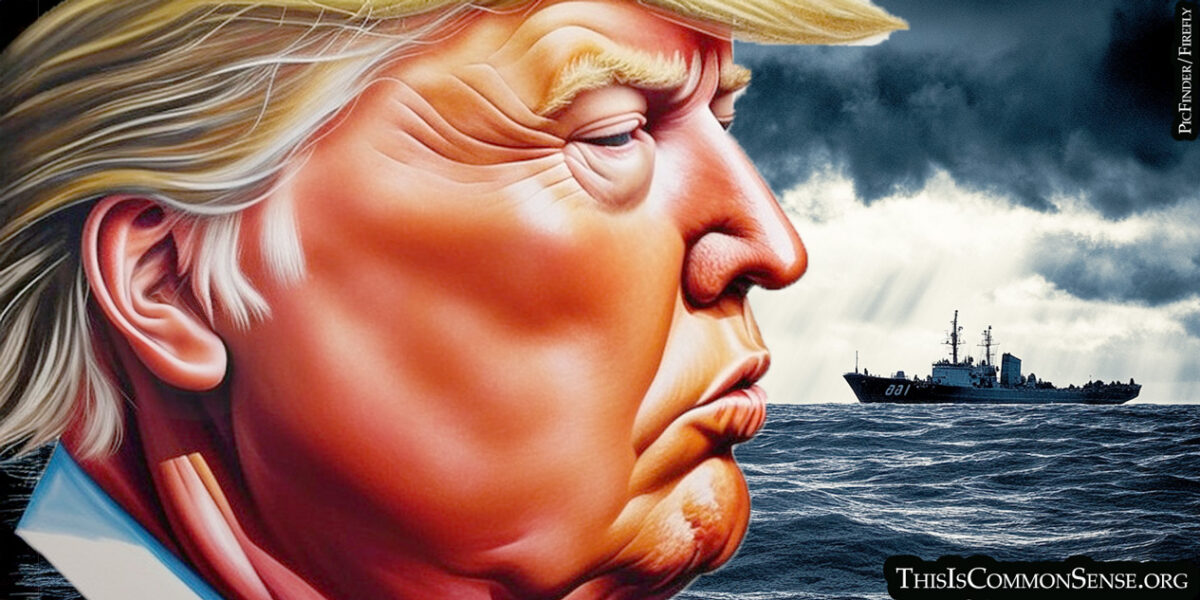
Illustration created with PicFinder and Firefly

See all recent commentary
(simplified and organized)
See recent popular posts
Categories
Thought

Joseph Robinette Biden, Jr.

In America, we resolve our differences at the battle box.

President Joe Biden, reassuring Americans after the failed assassination attempt upon his rival, former President Donald John Trump, on the previous day. Moments later he almost said “Make America Great Again.” July 14, 2024.
Categories
crime and punishment election law national politics & policies

Serious Times

Former President Donald Trump came a half-inch from being assassinated on Saturday. Thank goodness he’s alive. 

Let’s reflect for a moment on what would have happened to our country had Mr. Trump not turned his head slightly just before the bullet hit his right ear. 

Potentially serious violence and unrest? Even if the sorrow, despair, and anger millions would feel at having their presidential candidate murdered in cold blood were to be completely peacefully received, what is the takeaway? 

It is destructive. We are less free if political power is dictated by the barrel of a gun. And it is the government’s job to prevent that from happening. 

Political talking heads are calling for a different tone and I’m all for that, so far as it goes. But it is a vague concept that no one agrees upon. And the answer certainly isn’t less freedom of speech. 

“You know the political rhetoric in this country has gotten very heated,” President Biden told the nation last night. “It’s time to cool it down.” 

I think, instead, it is time for Mr. Biden to turn up the heat: on the Secret Service. 

This weekend’s deadly* shooting represents an epic failure. To allow a would-be assassin to climb onto the roof of a building 140 yards away, a rifle in hand and in line of sight of a former president giving a speech, demonstrates an incredible level of incompetence

Heads must roll at Secret Service. (Figuratively.) A new and beefed-up detail should be protecting Trump. And it is past time for RFK, Jr., to be granted Secret Service protection as well.

I don’t say this often but . . . spend the money! 

This is Common Sense. I’m Paul Jacob. 


* Corey Comperatore, a father sheltering his family with his body, was struck by a bullet and killed. Two others were seriously injured by the gunfire. Also, the shooter was killed by Secret Service snipers. 

PDF for printing

See all recent commentary
(simplified and organized)
See recent popular posts
Categories
Thought

William Whewell

In art, truth is a means to an end; in science, it is the only end.

William Whewell, Philosophy of the Inductive Sciences (1840), Aphorism 25.
Categories
Today

“Malaise”

On July 15, 1976, Jimmy Carter accepted the nomination of the Democratic Party to run for the presidency.

Three years later, as president, he gave his infamous “malaise” speech, in which he focused on energy but did not mention the one thing that actually helped turn the 1970s’ energy crisis around: the phased deregulation of oil prices that had started three months earlier, under his own directive. Instead of touting this deregulatory effort, Carter did the politic thing, promising a number of new government programs while extensively grinding a “crisis of confidence” message and vaguely speaking of a spiritual challenge.

The deregulation was startlingly effective, in the long run — though the immediate effect was a rocketing of prices. These high prices presented profit opportunities, and (lo and behold!) domestic production greatly increased, allowing for many, many years of lower prices. Those high prices would have worked better as market signals had not Carter and Congress also established “windfall profits” taxes, to take away those temporary gains to existing business.

Had Carter deregulated prices earlier, he would probably have been re-elected president. Had he emphasized deregulation, he probably would have beat back Ronald Reagan’s free market rhetoric — with actual action.

The price controls had been put in place earlier in the decade by the Republican president at the time, Richard M. Nixon, with the great help of his aides Dick Cheney and Donald Rumsfeld.

Categories
FYI

What We’re Reading

  • Democrats are staging a coup by the elite’s elite,” by J. T. Young — ‘As party brass scramble to oust President Biden, America is witnessing an attempted coup by the elite’s elite. Gone is any pretext that this is the “demos” or the people, governing. Today’s Democratic Party is about the aristocracy ruling.
  • Why Are There So Few Assassinations?” by Richard Hanania — ‘The era from the late nineteenth century to the early twentieth century was a kind of golden age of political assassinations. Over a twenty-year period, the political leaders or reigning monarchs of the US, France, Russia, Italy, and Spain were all murdered. . . . And then things just stopped. Other eras would see isolated political assassinations, but the period from 1881 to 1914 was like nothing that happened before or since. It might seem natural to ask what went wrong during this one period in history. But given what we know about the world, I think the better question is why there have been so few political assassinations in other eras.’
  • Donald Trump Assassination Attempt: 2023 Television Ad Features 20-Year-Old Shooter Thomas Matthew Crooks,” with video — ‘Thomas Matthew Crooks, the 20-year-old shooter who tried assassinating former US President Donald Trump at his campaign rally in Butler, Pennsylvania on Sunday was allegedly featured in a BlackRock advertisement in 2023.’
  • 5 lessons from working at a homeless shelter,” by Ed Latimore — ‘I watched about 500 homeless people get processed. . . . Most of them were guys who’d done 5-10+ years in prison, and their friends/family moved on. Since they’re convicted felons, the criminal justice system makes it virtually impossible for them to get work.’
  • The Temu App Is Like the TikTok App,” by Scribbler — ‘The app for China-based TikTok isn’t the only one to avoid if you worry about cybersecurity and whether any of your personal data might end up on the servers of the Chinese Communist Party. . . . Any app made by a company based in China and thus answerable to the party-state is suspect.’
Categories
Thought

Donald Trump

Fight, fight, fight!

Donald John Trump, former president running for a second term, in Butler, Pennsylvania, just after an assassination attempt, surrounded by Secret Service, pumping his right fist into the air, defiantly. These words are interpreted from his lips, the audio being obscure.

I was shot with a bullet that pierced the upper part of my right ear. I knew immediately that something was wrong in that I heard a whizzing sound, shots, and immediately felt the bullet ripping through the skin. Much bleeding took place, so I realized then what was happening. GOD BLESS AMERICA!

Trump’s first Truth Social post after the event. The assassination attempt occurred about a quarter after Six O’Clock EDST on July 13, 2024.
Categories
Today

The Bastille Stormed

On July 14, 1789, Paris citizens stormed the Bastille.

The word “storm” in its various forms is almost invariably paired with “Bastille” in discussions of the event. It is one of the great clichés of historical chitchat.


On the same date nine years later, in America, the Sedition Act was signed into law, prohibiting the writing, publishing, or speaking false or malicious statements about the United States government.

The passage of this repressive law spurred the formation of the first opposition party in the United States, with Thomas Jefferson as its leader and figurehead.