“Look, all administrations, all governments lie, all officials lie and nothing they say is to be believed. That’s a pretty good rule.”
Categories
“Look, all administrations, all governments lie, all officials lie and nothing they say is to be believed. That’s a pretty good rule.”
The Trayvon Martin shooting has gripped the nation for weeks now. In my Townhall column on the subject, nearly two weeks ago when we didn’t know as much of what we think we know now, I withheld judgment on the actual responsibility for the shooting:
We know too little about Mr. Zimmerman’s state of mind before or during this tragic clash. But whether his shooting of Trayvon Martin was spurred by race or an itchy trigger finger or a hero complex or something we know absolutely nothing about, or was actually somehow in self defense, is beside the point.
The point is that our justice system ought to get to the bottom of it.
And I concluded that public reaction and a free press were doing what is required in such cases, spurring government action.
But I need to make an amendment: Not all media are equal; some have behaved in socially irresponsible ways. NBC especially. This major news source aired George Zimmerman’s call to the police, but with a drastic editorial cut — and this sound edit pre-disposed all listeners to think Mr. Zimmerman a racist. After an “investigation,” the network apologized.
But not on air. Those poor souls relying on NBC still may think that Zimmerman was racially profiling Martin, could think nothing but.
Shame on NBC for not apologizing on air, but in a press release. And for not apologizing to Mr. Zimmerman. And for offering no explanation of what happened. The news source’s sound edit was more than a distortion, says Brent Bozell of the Media Research Center, it advanced “a falsehood.”
Poor reporting is disappointing, but the press bearing false witness is something much worse.
This is Common Sense. I’m Paul Jacob.
“Little else is requisite to carry a state to the highest degree of opulence from the lowest barbarism but peace, easy taxes, and a tolerable administration of justice: all the rest being brought about by the natural course of things.”
On April 6, 1776, the Continental Congress opened all U.S. ports to international trade with any part of the world not under British rule. Under Britain’s mercantilist policies, all American imports and exports had to pass through Great Britain on their way to and from the colonies.
On April 6, 1862, the Battle of Shiloh began in Tennessee.
On April 6, 1929, Governor Huey P. Long was impeached by the Louisiana House of Representatives. But the Senate needed a two-thirds majority to convict and, when a number of state senators pledged not to vote against Long no matter the evidence, the drive to remove Long was suspended.
Q. Why are the bills on farmers’ feed caps rounded?
A. So they fit inside the mailbox as each farmer roots around for his government check.
Old joke — and a useful reminder of how subsidy-dependent agriculture has become. Scott Faber, writing in The Washington Times, barrels right into the subject:
From 1995 to 2010, taxpayers provided nearly a quarter-trillion dollars in subsidies to farm businesses. Only one-third of America’s farmers grow crops that are even eligible for these subsidies, and the top 10 percent of these operations collected 74 percent of available funds. More and more farm payments are being delivered as premium subsidies for farm insurance policies. As more farm businesses purchased government-subsidized insurance, the cost to taxpayers has exploded: from $2.4 billion in 2001 to nearly $9 billion in 2011.
So the joke doesn’t quite limn the nature of today’s agribiz subsidies, which tend to be concentrated in the bigger businesses, not the more sympathetic “family farm.”
Faber notes that, today, as profits rise so do discoveries of insurance fraud . . . and yet farm lobbyists now trot out subsidy extension packages, even to the point of erecting new entitlement programs.
Just what we need, an even more dirigiste agricultural policy.
Faber proposes to cut back on covering farmers’ “shallow” losses — cover “deep” ones only. Move away from an agribiz “entitlement” system. Help reduce the federal deficit, not pile up more bushels of debt. That’s a start, at least.
Certainly, something must be done: Farm legislation is up for renewal this year.
But will Midwestern politicians wearing feed caps dare cut back?
This is Common Sense. I’m Paul Jacob.
“Character, not circumstances, makes the man.”
“One man cannot hold another man down in the ditch without remaining down in the ditch with him.”
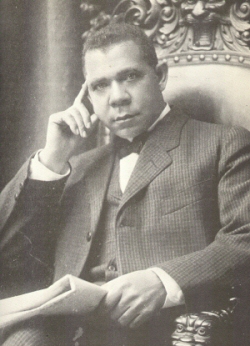
On April 5, 1792, George Washington exercised the first presidential veto of a congressional bill, a new plan for dividing seats in the House of Representatives, which would have increased the number of seats for northern states. Washington vetoed only one other bill during his two terms in office, an act that would have reduced the number of cavalry units in the army.
On April 5, 1856, Booker T. Washington, American educator, first leader of the Tuskegee Institute in Alabama, author of 14 books, including his autobiography, “Up From Slavery,” was born a slave in southwestern Virginia. Though Washington faced criticism from leaders of the new NAACP, especially W. E. B. Du Bois, for not protesting the lack of civil rights more strongly, he secretly funded litigation for civil rights cases, such as challenges to southern constitutions and laws that disfranchised blacks.
When you hear the word “unprecedented,” reach for your . . . dictionary.
As I’ve noted before, the word no longer sports its traditional meaning.
On Monday, President Barack Obama commented on the possibility that the Supreme Court would strike down the 111th Congress’s Patient Protection and Affordable Care Act by saying that such a move would constitute “an unprecedented, extraordinary step of overturning a law that was passed by a strong majority of a democratically elected Congress.” Yesterday, a three-judge panel of the Fifth Circuit Court of Appeals ordered the Justice Department to clarify the president’s statement. By Thursday.
Does the president — who happens to have taught constitutional law — really think the courts do not have the power to review and disqualify law on the basis of constitutionality?
As reported on CBS News’s Crossroads site, “Overturning a law of course would not be unprecedented — since the Supreme Court since 1803 has asserted the power to strike down laws it interprets as unconstitutional.”
I’d like to take a moment and thank the president . . . for help making the Constitution a live topic of conversation these days. But there’s something worrisome here. The president knows better. This is even worse than, say, Newt Gingrich totally messing up his comments on “activist judges,” making hash of law and interpretation. This is a president with a Harvard-established reputation on the subject saying something patently untrue.
He could only have been “fibbing.” And hoping to get away with it . . . apparently on the supposition that Americans are so miseducated we wouldn’t even notice.
We noticed.
This is Common Sense. I’m Paul Jacob.
“Deep down in our non-violent creed is the conviction there are some things so dear, some things so precious, some things so eternally true, that they’re worth dying for. And if a man happens to be 36-years-old, as I happen to be, and some great truth stands before the door of his life – some great opportunity to stand up for that which is right.
“A man might be afraid his home will get bombed, or he’s afraid that he will lose his job, or he’s afraid that he will get shot, or beat down by state troopers, and he may go on and live until he’s 80. He’s just as dead at 36 as he would be at 80. The cessation of breathing in his life is merely the belated announcement of an earlier death of the spirit.
“A man dies when he refuses to stand up for that which is right. A man dies when he refuses to stand up for justice. A man dies when he refuses to take a stand for that which is true.”
On April 4, 1968, Dr. Martin Luther King Jr. was fatally shot on the balcony outside his second-story room at the Lorraine Motel in Memphis, Tennessee. King was struck in the jaw by a bullet that severed his spinal cord. The 39-year-old civil rights leader was pronounced dead on his arrival at a Memphis hospital. Following the assassination, riots broke out in cities across the country, with National Guard troops called out to quell unrest in Memphis and Washington, D.C.
On April 4, 1975, Microsoft was founded Albuquerque, New Mexico, as a partnership between Bill Gates and Paul Allen.