 A little knowledge is a dangerous thing, but a little want of knowledge is also a dangerous thing.
Categories
A little knowledge is a dangerous thing, but a little want of knowledge is also a dangerous thing.
“Today, government at all levels consumes 37 percent of the total economy, or GDP,” Mitt Romney said earlier this month. “If Obamacare is allowed to stand, government will reach half of the American economy.”
Glenn Kessler’s Fact Checker column at the Washington Post slapped that statement with four “Pinocchios,” the worst possible condemnation for telling “whoppers.”
Yet, Kessler acknowledges Romney’s point. In 2011, local, state and federal “government expenditures amounted to 37.34 percent of the gross domestic product.” That percentage is expected to climb to just over 39 percent by 2020.
“But Romney goes way too far,” writes Kessler. Romney counts private medical expenditures, which will supposedly account for 10 percent of the projected 2020 economy. Romney’s campaign spokesperson argues Obamacare in part mandates that spending and thus the 10 percent is part of government’s “reach.”
Of course, the vast majority of all private payments for medical care — the 10 percent — would happen with or without Obamacare. So Romney’s figure does exaggerate. Still, government commandeering 37 or 39 percent of our economy seems a whopping amount.
Moreover, in making his case against including private health care spending, Kessler argues, under Romney’s notion of government reach, “a wide variety of industries, such as banking or housing, should also be counted as part of this government-controlled economy.” Well, yes. Government spending accounts for nearly 40 percent of America’s GDP. Plus, government heavily regulates and interjects itself into major parts of the private sector.
Kessler thinks Romney’s statement is a real whopper, but Romney is on to something. What’s really whopping is government’s full reach, which includes over-reach.
This is Common Sense. I’m Paul Jacob.
This weekend on Townhall.com — it is Father’s Day!
Winning the lottery
Paul Jacob
June 17, 2012
My dad was trained as an accountant. So, why didn’t he just do the math?
According to the Department of Agriculture, it costs those American families categorized by Uncle Sam as “middle income” a whopping $234,900 to rear a child from birth to age 18. Families with household incomes of less than $59,000 supposedly spend $169,080 per kiddo; wealthier families (those earning more than $102,870 per annum) will fork out $389,670 per heir.
Wow. Mom and Dad had six kids. That’s almost $1.5 million.
Apparently the price tag has been greatly inflated since my parents’ day. Which naturally conjures up the next question: how have my wife and I financed our three?
It gets worse. These sticker shock numbers don’t even include the cost of pre-natal care, the birth itself or, on the back-end, putting the youngsters through college. And remember, college costs have increased ten-fold from when I went to school. Add another $50,000 to $80,000 to child-rearing if college costs are included . . . and the student chooses a less expensive university.
Of course, birthing in bulk creates some economy of scale. “Families with three or more children,” the Los Angeles Times reports. “spend 22 percent less on each child than parents with two or fewer.”
Be thankful, of course, that these are government statistics, which must be ingested with a healthy skepticism… (click here for the complete article)
And here are some links to the column in question:
 It is simplicity that makes the uneducated more effective than the educated when addressing popular audiences.
This week, on Stossel:
It is absurd to hold that a man ought to be ashamed of being unable to defend himself with his limbs but not of being unable to defend himself with speech and reason, when the use of reason is more distinctive of a human being than the use of his limbs.
Party politics is often underhanded.
Many of our country’s founders knew this all too well, and tried to avoid the factionalism of party politics. But still, two political factions emerged, and our politics has been dominated by two parties ever since.
And believe me, the two insider parties work mightily to rig the system in their favor. The presence of “sore-loser laws” is a case in point.
Now, political parties are private entities. They can choose whomever they want. Ideally, the ballots wouldn’t even list party affiliation. But “sore-loser laws” stretch in the other direction, preventing individuals from running in one party after losing a primary as a candidate for another party.
In this way, the parties use the law to secure their own positions. It has nothing to do with “democracy” or “voting rights,” everything to do with privilege.
In Michigan, whilom New Mexico Governor Gary Johnson ran in the primary as a Republican candidate for the presidency. Now, the Secretary of State is disallowing him from running as a Libertarian. You see, he’d filed some paperwork withdrawing his candidacy three minutes too late last November.
An amusing work-around may be in the offing, with a Texas businessman named Gary Johnson being groomed for the Michigan nomination. Take that, partisan insiders!
But regarding the Secretary of State’s ruling, the Libertarians smell a partisan rat, and are suing. It turns out they may have precedence on their side, since John Anderson had technically run afoul of the same law back in 1980, but nothing had been done to exclude him.
This time, Johnson’s more feared than Anderson was then. And, this time, the Secretary of State is a Republican.
This is Common Sense. I’m Paul Jacob.
J.P. Morgan Chase CEO Jamie Dimon testified before the Senate Banking Committee yesterday about the $2 billion in trading losses suffered by his company’s London office last month.
Congress is shocked that money can be lost trading derivatives. And our legislative leaders seem to seriously think they can write rules for banks and other financial institutions that protect everyone from such losses, making certain any trading in financial securities is guaranteed to earn a profit.
“We will lose some of our shareholders’ money,” Dimon acknowledged, “and for that, we feel terrible. But no client, customer or taxpayer money was impacted by this incident.” In fact, J.P. Morgan Chase is nonetheless expected to turn a profit this quarter — as it has consistently done since the financial crisis.
Still, some politicians and policy makers fear the nation’s largest bank is “too big to fail,” that a collapse could again threaten the stability of the entire economy.
I liked what Rob Cox of Reuters TV’s Fast Forward urged Dimon to tell the senators: “We are not going to fail, but if we do, the failure will be our own. We will bear it on our bond holders, our investors and it will not be a public problem.”
Cox went on to endorse “this idea that banks can go out and they can lose money and they can make money,” adding that “at the end of the day it’s their money, not our money, that’s at risk.”
In other words, no bailouts.
This is Common Sense. I’m Paul Jacob.
 War is as much a punishment to the punisher as to the sufferer.
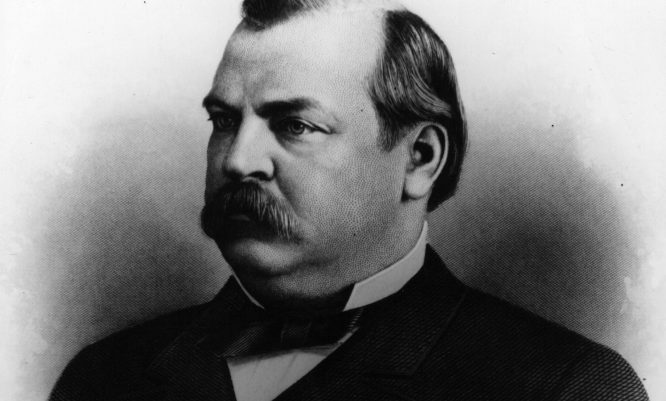
The lessons of paternalism ought to be unlearned and the better lesson taught that while the people should patriotically and cheerfully support their Government, its functions do not include the support of the people.
Stephen Grover Cleveland, Second Inaugural Address, March 4, 1893.