Categories
Today

The Bangorian Controversy

On March 31, 1717, a sermon on “The Nature of the Kingdom of Christ,” by Benjamin Hoadly, the Bishop of Bangor, provoked the Bangorian Controversy.

The sermon’s text was John 18:36, “My kingdom is not of this world,” and from that Hoadly deduced — supposedly at the request of King George I himself, who was present in the assembly — that there was no Biblical justification for any church government. Hoadly identified the church with the kingdom of Heaven, noting that Christ had not delegated His authority to any representative.

King George’s preference for the Whig Party, and for latitudinarianism in ecclesiastical policy, is widely thought to have been a strategic maneuver to degrade church power in political government.

Categories
Update

X to xAI

After Elon Musk purchased Twitter in 2022, the very American cause of free speech made a comeback. “Elon Musk’s sunlight on Twitter’s backroom censorship dealings,” wrote Paul Jacob on December 22 of that year, “has cast a black shadow upon the U.S. Government.” But that sunlight offered enlightenment, as well. 

We learned just how bad it had gotten under Biden’s first two years in office. “In sum, the federal government made Twitter its b … uh … disinformation agent.”

The triumph of freer speech had ramifications, from the amusing — leftists leaving Twitter (now X.com) for alternatives such as BlueSky, where they did not have to interact with those whom they disagree — to the momentous — the return of Donald Trump to the presidency. 

Elon and Twitter/X get much of the credit.

Now the latest news: “Tech billionaire Elon Musk’s xAI artificial intelligence firm has acquired his social media company X, formerly known as Twitter, for $33 billion (€30.5 billion),” writes Srinivas Mazumdaru. “Musk announced the transaction in a post on X, saying: ‘The combination values xAI at $80 billion and X at $33 billion ($45B less $12B debt).’

“xAI and X’s futures are intertwined,” he wrote. “Today, we officially take the step to combine the data, models, compute, distribution and talent. This combination will unlock immense potential by blending xAI’s advanced AI capability and expertise with X’s massive reach.”

Much of the deal’s specifics remained unclear. Both companies are privately held, so they are not required to disclose their finances to the public.

It’s also not clear if the move will change anything for X users.

“Elon Musk sells X to his AI company xAI,” DW, March 28, 2025.

Let’s hope speech on X — and on the Internet generally — becomes even freer.

Categories
Thought

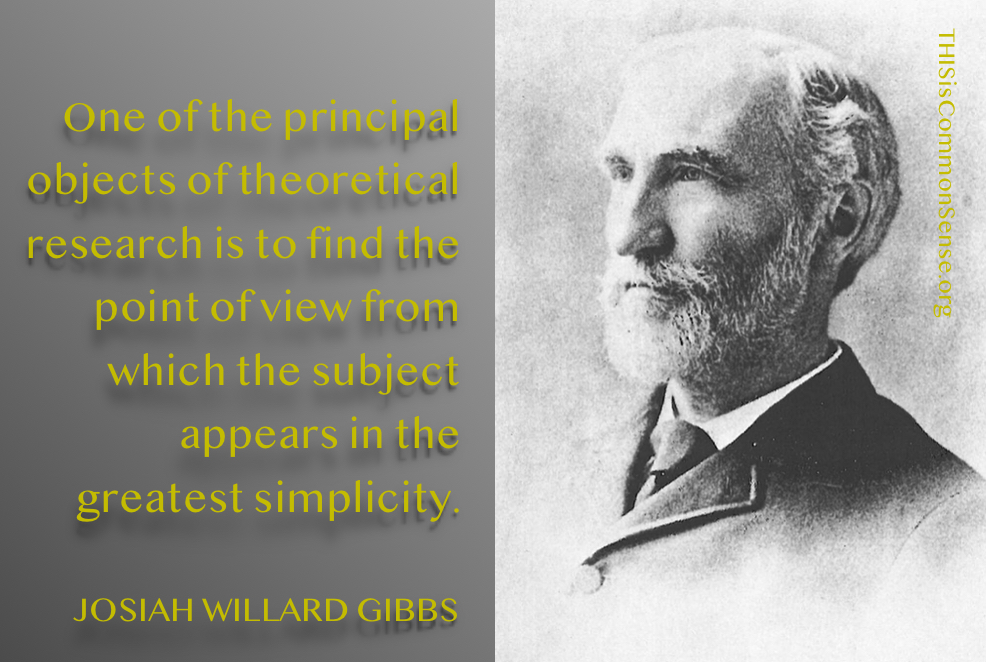
Josiah Willard Gibbs

One of the principal objects of theoretical research is to find the point of view from which the subject appears in the greatest simplicity.

Josiah Willard Gibbs, letter accepting the Rumford Medal (1881). Quoted in A. L. Mackay, Dictionary of Scientific Quotations (London, 1994).
Categories
Today

SpaceX Re-uses Rocket

On March 30, 2017, SpaceX conducted the world’s first reflight of an orbital class rocket.

Categories
Update

Stop the Subsidy!

“The whole point of taxes and government spending is to promote the general welfare, or so the standard theory runs,” Paul Jacob wrote two years ago. “But there’s nothing ‘general’ about the extreme sectarianism of ‘public radio and TV,’ with less well-to-do taxpayers subsidizing the far wealthier public media audience.”

That “extreme sectarianism” was on display this week in the hilarious questioning of Katherine Maher, Chief Executive Officer and President, National Public Radio, and Paula Kerger, Chief Executive Officer and President, Public Broadcasting Service.

This was part of the House Subcommittee on “Delivering Efficiency in Government,” which — like Elon Musk’s band of waste-cutters — initials down to DOGE:

A lot of this is hilarious. Must-see TV. Representative Jasmine Crockett was especially clueless in her comments, which have to be heard to be . . . believed?

Just remember what Paul’s said, though:

One shouldn’t need the latest ratcheting-up of the culture wars to oppose what we call, in America, “public radio and TV.” Taxpayer-subsidized broadcast media is a bad idea. Period. Full stop.

Defund NPR. Defund PBS. No more state-run or ‑subsidized media.

Paul Jacob, “Public TV Vetoed” (Common Sense, May 9, 2023).

Categories
Today

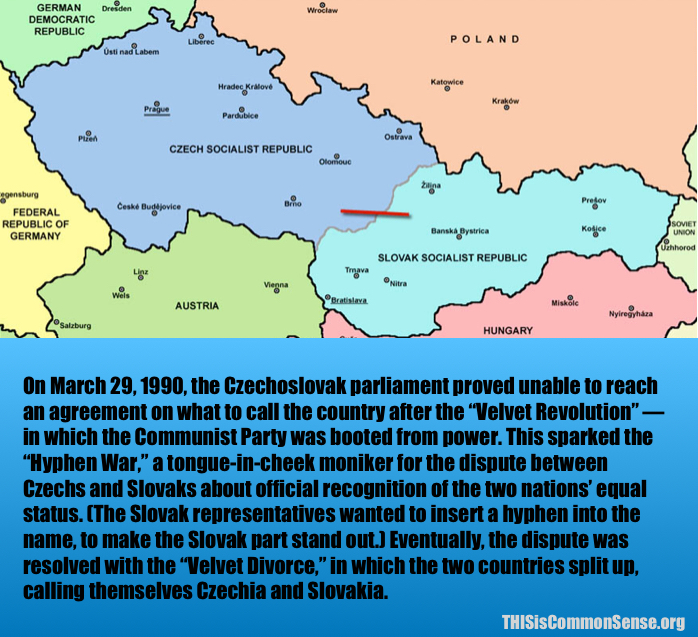
Hyphen War

On March 29, 1990, the Czechoslovak parliament proved unable to reach an agreement on what to call the country after the “Velvet Revolution” — in which the Communist Party was booted from power. This sparked the “Hyphen War,” a tongue-in-cheek moniker for the dispute between Czechs and Slovaks about official recognition of the two nations’ equal status. (The Slovak representatives wanted to insert a hyphen into the name, to make the Slovak part stand out.) Eventually, the dispute was resolved with the “Velvet Divorce,” in which the two countries split up, on New Year’s Day, 1993, the two countries now being named:

Czech Republic, also known as Czechia;

Slovakia, officially the Slovak Republic (Slovak: Slovenská republika).

Categories
Thought

Ismo

There is actually more debt in the world than there is money. So yes, probably, it’s gonna get paid — as soon as we borrow something from another planet.

Ismo Leikola, from a stand-up bit shown on a Facebook “reel.”
Categories
First Amendment rights privacy

What’s Really at Stake in Maine

It’s “bad-penny” time in the Maine legislature, as in “back like a”: a bill threatening the privacy of political donors.

LD951, introduced and foiled in the previous session, would force nonprofit organizations that take a position on policy measures “to not only report their donors, but their donors’ donors,” which Philanthropy Roundtable compares to legislation in Arizona that did become law — a law now being challenged in court. 

Like Arizona’s law, LD951 would impose cumbersome regulations and steep fines while obstructing free speech and free association. The obviously intended result being for nonprofits to not take such positions.

According to LD951, the public has a “compelling interest” in knowing who political donors are; otherwise, how can voters “make informed decisions and hold elected officials accountable”?

This is one of those vague dicta that melts into a puddle when you try to think about it.

Say you’re a 2024 voter deciding between Harris and Trump. Before you can decide, must you know who is donating to each campaign, name by name, and ponder those names before you can possibly. . . . No?

Last I checked, you can indeed assess views, character, programs, competence even without an exhaustive review of donor lists.

Meanwhile, donors, and donors to donors, often have a compelling interest in anonymity. Not because they’re ashamed of their political commitment but because they know that there are wackos out there ready to hound people because of what they believe in.

The insanos might even scrawl Nazi symbols on — or even set ablaze — their automobiles!

The people willing to be public punching bags? They are called candidates. Others may prefer to remain behind the scenes.

This is Common Sense. I’m Paul Jacob.


PDF for printing

Illustration created with Krea and Firefly

See all recent commentary
(simplified and organized)
See recent popular posts

Categories
Thought

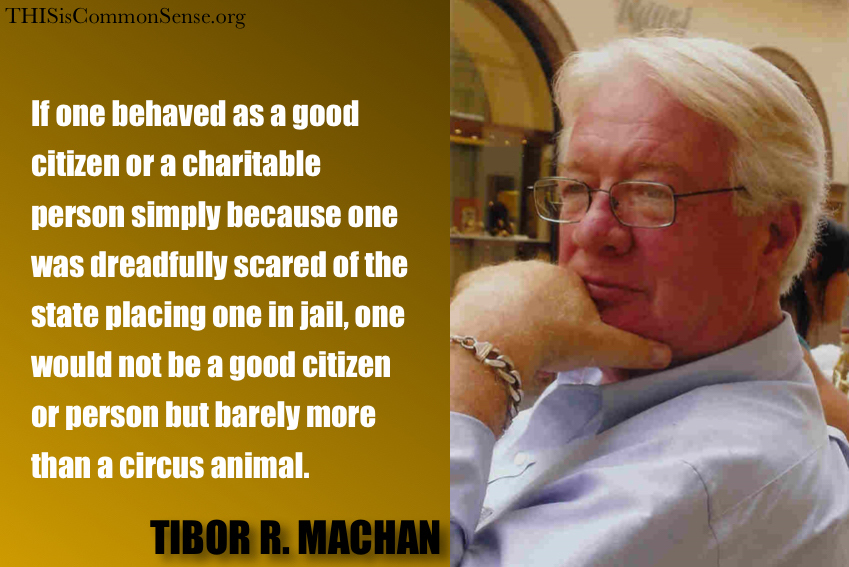
Tibor R. Machan

If one behaved as a good citizen or a charitable person simply because one was dreadfully scared of the state placing one in jail, one would not be a good citizen or person but barely more than a circus animal.

Tibor R. Machan, Classical Individualism: The Supreme Importance of Each Human Being (1998), p. 11.

Categories
Thought

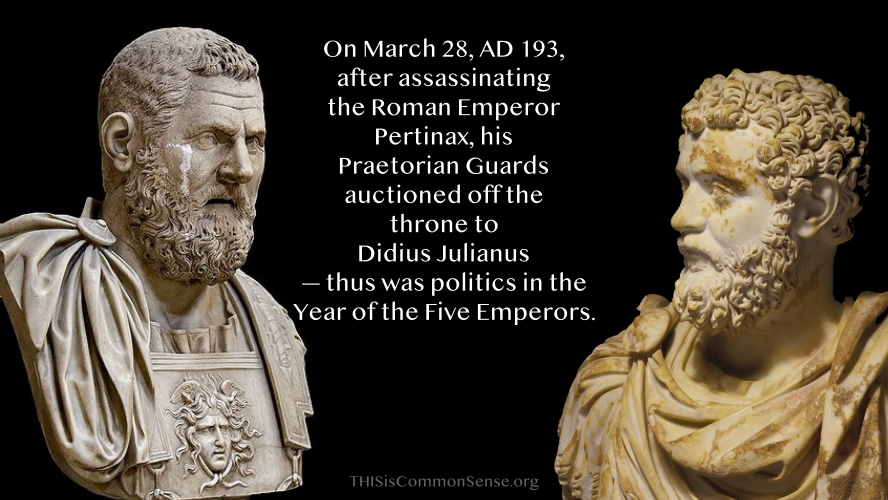
Pertinax Dispatched

On March 28, AD 193, after assassinating the Roman Emperor Pertinax, his Praetorian Guards auctioned off the throne to Didius Julianus — thus was politics in the Year of the Five Emperors.