“The nature of man is indivisible; you cannot cut him across, and give one share of him to the state and leave the other for himself.”
Auberon Herbert, The Right and Wrong of Compulsion by the State (1885)
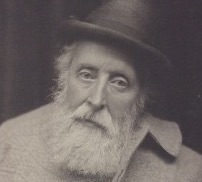
“The nature of man is indivisible; you cannot cut him across, and give one share of him to the state and leave the other for himself.”
Auberon Herbert, The Right and Wrong of Compulsion by the State (1885)
“A man can only learn when he is free to act.”
Auberon Herbert, The Right and Wrong of Compulsion by the State (1885)

In 1941, Václav Klaus was born; other June 19 births include Salman Rushdie in 1947, Kathleen Turner in 1954, and Laura Ingraham in 1964.
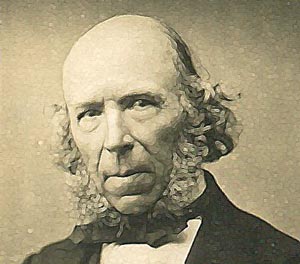
“He who carries self-regard far enough to keep himself in good health and high spirits, in the first place thereby becomes an immediate source of happiness to those around, and in the second place maintains the ability to increase their happiness by altruistic actions. But one whose bodily vigour and mental health are undermined by self-sacrifice carried too far, in the first place becomes to those around a cause of depression, and in the second place renders himself incapable, or less capable, of actively furthering their welfare. In estimating conduct we must remember that there are those who by their joyousness beget joy in others, and that there are those who by their melancholy cast a gloom on every circle they enter.”
Herbert Spencer, The Principles of Ethics: Data of Ethics, § 72, pp. 193-194
On June 18, 1838, Auberon Edward William Molyneux Herbert was born.
Auberon Herbert was a Liberal Member of Parliament who, after reading the writings of Herbert Spencer, became a radical individualist and author of essays such as “The Ethics of Dynamite,” “A Politician in Trouble About His Soul,” and “The Right and Wrong of Compulsion by the State.”
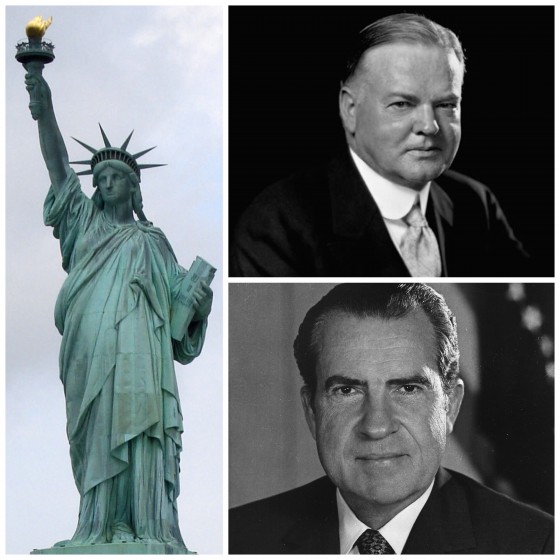
The Statue of Liberty arrived in New York Harbor on June 17, 1885. On the same day in 1930, progressive Republican President Herbert Hoover — eager to please agricultural states, and confident that protectionism would yield greater wealth — signed the Smoot-Hawley Tariff. The Great Depression deepened, especially as provisions of the bill took effect.
Three years later, investment author and two-time Libertarian Party presidential candidate Harry Browne was born.
On June 17, 1944, Iceland declared independence from Denmark.
On this day in 1971, President Richard Nixon declared a “War on Drugs,” which steadily decreased civil liberty and the rule of law in America.
Exactly one year later, five men were arrested for attempted burglary on the offices of the Democratic National Committee in the Watergate complex in Washington, D.C., igniting the Watergate scandal that ultimately led to the resignation of U.S. President Richard Nixon more than two years later.
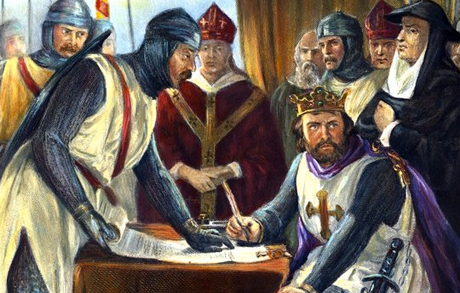
“For a trivial offence, a free man shall be fined only in proportion to the degree of his offence, and for a serious offence correspondingly, but not so heavily as to deprive him of his livelihood.”
Magna Carta Libertatum, Clause 20.
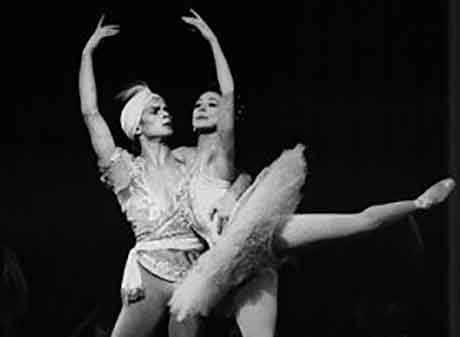
On June 16, 1961, dancer Rudolf Nureyev defected from the Soviet Union.
The great Scottish moral philosopher, political economy pioneer, and Enlightenment intelectual Adam Smith (1723-1790), best known for authoring the 1776 masterwork The Wealth of Nations, was born on June 16.
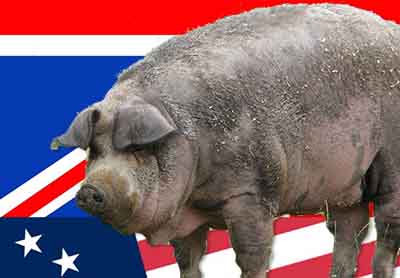
The Oregon Treaty, signed June 15, 1846, established the boundary between Great Britain’s Canadian territory and the United States of America, from the Rocky Mountains to the Strait of Juan de Fuca, using the 49th Parallel as the handy marker. However, the treaty was not exactly clear on the territorial status of the San Juan Islands, so exactly 13 years later, to the day, a war erupted, over a shot pig.
Basically, an American farmer shot a pig rooting through his garden. The pig belonged to an Irishman. The two did not agree upon compensation, and “the authorities” were called in, with infantry mustering from the south and the Governor of Vancouver Island instructing marines to land on San Juan Island — though the rear admiral in charge refused to comply with the order, on the reasonable grounds that war over a pig was not worth it. Local troops from both sides lined up against each other, but under command to defend themselves only and not shoot first. All that was exchanged in this war were insults. It turned out to be a bloodless war, discounting the pig, so it might qualify as the best war in American history.
On June 15, 1992, Vice President Dan Quayle incorrectly added an “e” to the end of a Trenton, N.J., sixth grader’s correctly spelled “potato.”
“The basis of a democratic state is liberty.”
Aristotle, Politics, Book Six.