Do the young think that their trendy-again socialist notions are new?
There’s no hat older than socialism. Our civilization has been grappling with socialist ideas for at least two centuries. While the arguments for and against socialism are many and varied, maybe it all boils down to ignorance and greed.
“This century’s socialist wave starts at a big disadvantage,” wrote Holman W. Jenkins, Jr., for the Wall Street Journal, yesterday. “It arrives as the socialism we already have runs out of that famous quantity, other
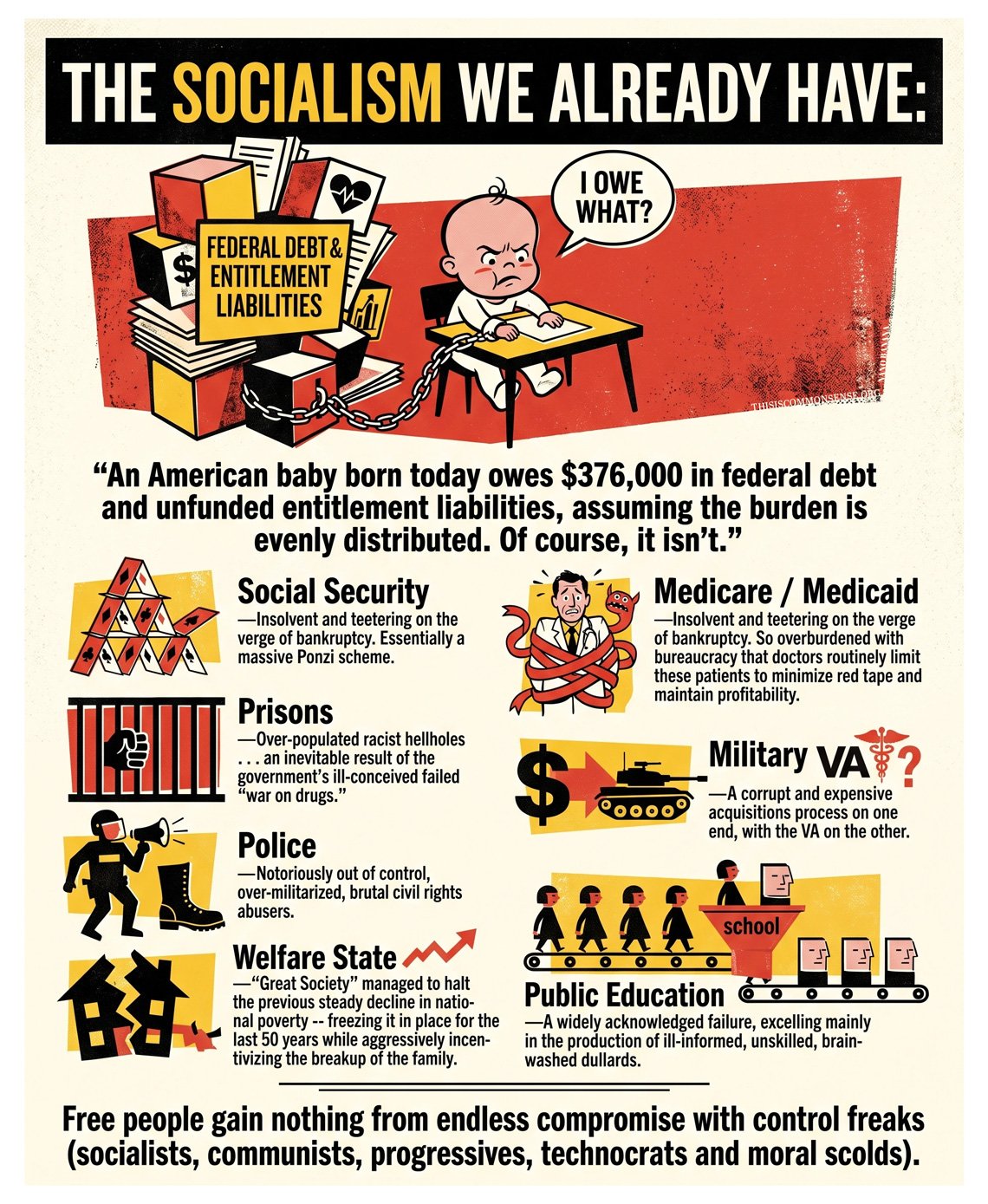
Today’s allegedly “democratic” socialists use “the socialism we already have” as an excuse for more. Truth is, we cannot afford what we now must put up with.
“An American baby born today owes $376,000 in federal debt and unfunded entitlement liabilities, assuming the burden is evenly distributed,” explains Mr. Jenkins. “Of course, it isn’t. We oldsters plan on checking out before the bill comes due.”
The intergenerational conflict of actually-existing socialism has been buried under nice phrases like “Social Security” — even as that specific program teeters, insolvent, requiring re-jiggering to ratchet up burdens on the young every other generation.
I see why the young would object. It’s harder to see why they would want more of the dog that bites them.
“Let me be the 1,000th to notice that the New York socialism of Mayor Zohran Mamdani seems to appeal especially to privileged young people, still supported in adulthood by their parents.”
And let me be the millionth to observe that demanding other people do your work and pay your bills amounts to exactly what these very nice socialists have always railed against.
Greed.
This is Common Sense. I’m Paul Jacob.
Illustration created with Nano Banana
See all recent commentary
(simplified and organized)
See recent popular posts
One reply on “The Greed of Socialism”
Before the embarrassments of fascism and of National Socialism, the agreed definition of “socialism” was straight-forward: “A theory or policy of social organization which aims at or advocates the ownership and control of the means of production, capital, land, property, etc., by the community as a whole, and their administration or distribution in the interests of all.” (OED)
After that embarrassment, many of those socialist who did not self-identify as fascists nor as Nazis sought to redefine the word to exclude both. But they couldn’t quite agree amongst themselves, and so redefinitional chaos began.
Moreover, quite a few socialists sought to make socialism seem more appealing by speaking and writing of what socialism would supposèdly accomplish, without offering a clear idea of the means.
Now-a-days, the typical person who calls him- or herself a “socialist” is a Useful Idiot with no coherent notion of what socialism is. He or (more likely) she just believes that some clever, caring people can reörganize the economic order to make everyone materially comfortable. These folk don’t really know much about the various failed interventions of the present, and often don’t classify them as socialist.
Additionally, amongst those who self-identify as “socialist” with or without a coherent idea, an implicit tautology prevails:
If everyone were virtuous enough, then they would be able to make socialism work.
This tautology is vacuous, because it presumes that some level of virtue would be sufficient to make socialism work, whereäs socialism cannot work even with a population of nothing but saints. But, in the context of embracing the idea that some level of virtue would be sufficient, even a recognized failure of socialism will not be seen as a reason to quit trying. The socialists can always tell themselves “We can succeed next time, or at least fail better.” All the past failure, all the past suffering, all the past death seem as nothing to them when they imagine reaching a time of indefinite span in which life will be better for everyone.
And, of course, such thinking is still easier when these folk imagine themselves as benefitting in the near term.