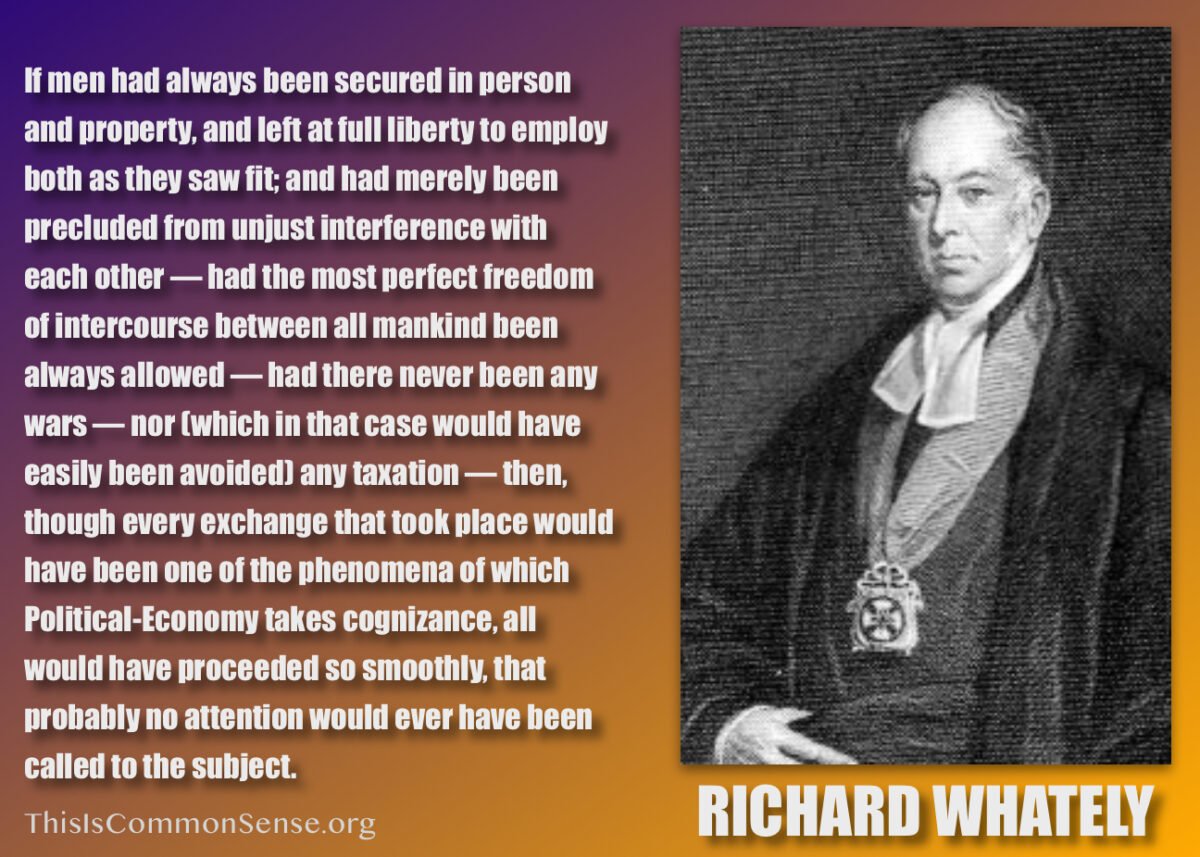
I wish for my own part there were no such thing as Political-Economy. I mean not now the mere name of the study: but I wish there had never been any necessity for directing our attention to the study itself. If men had always been secured in person and property, and left at full liberty to employ both as they saw fit; and had merely been precluded from unjust interference with each other — had the most perfect freedom of intercourse between all mankind been always allowed — had there never been any wars — nor (which in that case would have easily been avoided) any taxation — then, though every exchange that took place would have been one of the phenomena of which Political-Economy takes cognizance, all would have proceeded so smoothly, that probably no attention would ever have been called to the subject. The transactions of society would have been like the play of the lungs, the contractions of the muscles, and the circulation of the blood, in a healthy person; who scarcely knows that these functions exist. But as soon as they are impeded and disordered, our attention is immediately called to them.
Richard Whately, Introductory Lectures on Political Economy (1832), Lecture III.
Categories
Richard Whately
One reply on “Richard Whately”
Though the scope of the term “political economy” is often taken to be conterminous with that of “economics”, and the study of what we call “economics” emerged largely from that which was called “political economy”, some authors distinguish the two, and I think that, to defend Whately here, we must make such a distinction. For, at present, economics entails economically rational decision-making; and, certainly, people do not all manage to engage in such decision-making, unguided, nor is a lack of liberty the only impediment to their doing so.
People can live better lives after being taught to recognize the true cost of any choice as the best forgone state-of-the-world, to understand that sunk costs are sunk, and so forth.