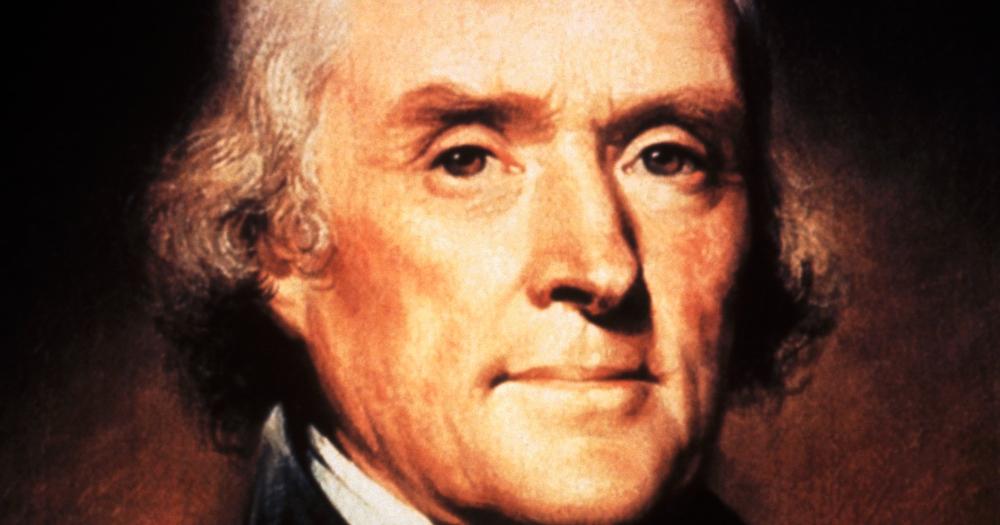
When Thomas Jefferson entered the White House, he promptly began firing civil servants, high-level and -low. It was a big house-cleaning effort, a streamlining after Federalist bloat. The new Democratic-Republican president demanded an efficient and minimal government.
Since then, it’s gotten harder for presidents to do such big house-cleaning jobs, as The Epoch Times explains in a new article:
For months, federal judges have been ordering President Donald Trump to reinstate heads of agencies despite his interest in removing them.
Their decisions have been based on a 90-year-old Supreme Court precedent, known as Humphrey’s Executor v. United States, that says Congress can limit the reasons for which presidents remove officials like members of labor boards.
However, that precedent and various legal blocks on Trump’s firings could be removed depending on how the Supreme Court rules in an upcoming case — potentially giving Trump and his successors more flexibility with personnel.
Sam Dorman, “Supreme Court Set to Consider Trump’s Power to Remove High-Level Bureaucrats,” The Epoch Times (December 6, 2025).
The case, Trump v. Slaughter, goes before the union’s highest court on Monday. It regards Trump’s firing of Rebecca Slaughter as a commissioner of the Federal Trade Commission (FTC).
Something to remember about this “balance of powers” case is that it is not about balancing the constitutional “three branches” of the general government. The permanent bureaucracy, insulated from firing by the “Executive,” has, arguably, become a de facto fourth branch, uncontrolled by an inertial Congress as well as the elected president.
Whatever the Supreme Court decides, the effects of its decision are expected to ripple through many other cases — including ones involving Trump.
For example, two fired labor board officials have filedamicus briefs suggesting the outcome of Slaughter’s case could impact their cases as well.
Trump has not only challenged Humphrey’s Executor but said that even if Congress can insulate certain officers from removal, judges shouldn’t be able to reinstate those officers.
Sauer told the court that while fired officers can seek back pay, their reinstatement intruded on executive power and forces the president to “entrust executive power to someone he has removed.”
Slaughter disagreed, arguing “there is no Article II problem with requiring the President to ‘entrust executive power to someone he has removed’ if he has no Article II authority to remove that person in the first place,” her brief added.
The Supreme Court’s recent decisions on its emergency docket indicated it was sympathetic to Trump’s position.
In at least five separate cases, including Slaughter’s, the justices have allowed Trump to temporarily fire officials as litigation unfolded.
The court has repeatedly said that the executive branch “faces greater risk of harm from an order allowing a removed officer to continue exercising the executive power than a wrongfully removed officer faces from being unable to perform her statutory duty.”
Ibid.
The issue is obviously complicated. The Epoch Times article does a pretty good job explaining that complexity.
One reply on “Will Trump Be Allowed to Fire Bureaucrats?”
The real problem is that, with regulatory agencies such as the FTC, Congress has unconstitutionally delegated Congressional responsibility to the Executive branch. The felt sense that the President ought not to be able to seize control of regulation by hiring and firing regulators at will — and thus to become a dictator de facto — in the original sense of “dictator” — is, by itself, sound enough; but the leftist impulse to preserve an independent fourth branch is grossly unsound.