Once upon a time, I didn’t think “culture war” issues were important. Give me liberty or — at least lower taxes and allow better representation in Washington.
But in recent years, as the left went woke and the right went MAGA, a number of cultural issues became . . . salient. Unavoidable. Key, even.
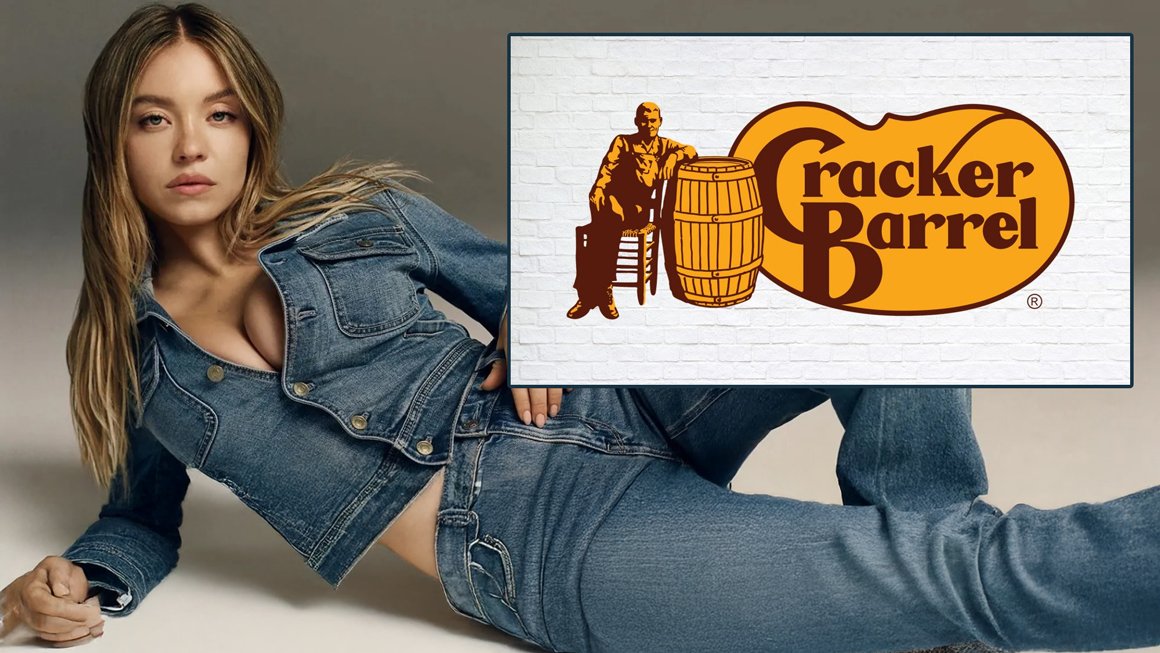
In “The Corporate Logo That Broke the Internet,” David French — late editor of National Review and now token rightist for The New York Times — defends the Cracker Barrel logo rebranding effort, where the image of an old man (Uncle Herschel, in Cracker Barrel lore) leaning against a barrel,” as French describes it, was removed.
Also removed? The tagline on the old logo: “Old Country Store.” All that was left was “Cracker Barrel” on a yellow field.
O, the uproar! And from the right!
Mr. French thinks it all very stupid. “Right-wing activists did the same thing that they mocked the left for in the [Sydney] Sweeney [American Eagle ad] affair. They looked at a completely normal, innocuous marketing effort, deemed it to be deeply politically coded and then lashed out.”
He contends that the protesting “voices never really explained how a plain logo with the restaurant’s name was woke,” yet the explanation is right before us, staring us in the face everywhere we go.
It was “woke” for corporations to remove beloved commercial icons such as Aunt Jemima, Uncle Ben (now “Ben’s Original”), and “Mia,” the Land O’Lakes Indian maiden. In each of these logos the supposedly “offensive” and “stereotypical” images were removed ostensibly to avoid offending the easily offended. Leaving customers with blank, unoriginal, uninspiring and non-comforting signage.
Exactly what happened when the corporate bigwigs took out the iconography from the Cracker Barrel logo: All nostalgia liquidated.
Cultural erasure used to be a leftist theme, but thanks to today’s enlightened corporations, it has become universal, as the soullessness of modish symbology has become painfully obvious.
Define woke as erasure in the name of non-erasure. Opposing erasure generally is the defense of culture. That’s not a manufactured “outrage,” or a form of “bullying,” as French asserts.
It’s just Common Sense! I’m Paul Jacob.
See all recent commentary
(simplified and organized)
See recent popular posts
3 replies on “Cultural Erasure”
Restaurants are sometimes very generic in everything that they offer, but normally they seek to differentiate themselves not only in terms of the food and drink that they serve, but in terms of ambience. They sell ambience. Some restaurants are very successful in large part because of their ambience, not-withstanding that, in many cases, the ambience that attracts many repels others. The CEO of Cracker Barrel proposed to make the ambience far more generic. How plausible is it that the people repelled by the established ambience would offer more profit than the people who would be lost by abandoning that ambience? And, if greater profit were not pursued, then what were the objective?
From outside Cracker Barrel, we didn’t so much see a positive defense of the rebranding as a counter-attack on those who attacked the rebranding. The counter-attackers often let slip that they didn’t much like the food served or the various items sold in the gift shops. If these dismissals were correct, one had no reason to go to Cracker Barrel, with or without the rebranding.
The more I think about it, the more I think the whole thing was itself a marketing effort.
“Let’s come up with something that will get the woke right even more agitated than they got when we started offering the Impossible Sausage patty. Coming up with a vanilla logo is cheap, and we’ll never have to go to the expense of actually changing the signs or anything — just pretending we’re going to will have everyone talking about Cracker Barrel. We’ll get $50 million worth of publicity out of an AI-generated drawing and a press release!”
The alternative explanation — that they didn’t expect Robby Starbuck and Co. to start babbling nonsense — isn’t that credible.
That’s an interesting possibility. Sort of like yesteryear’s New Coke play.