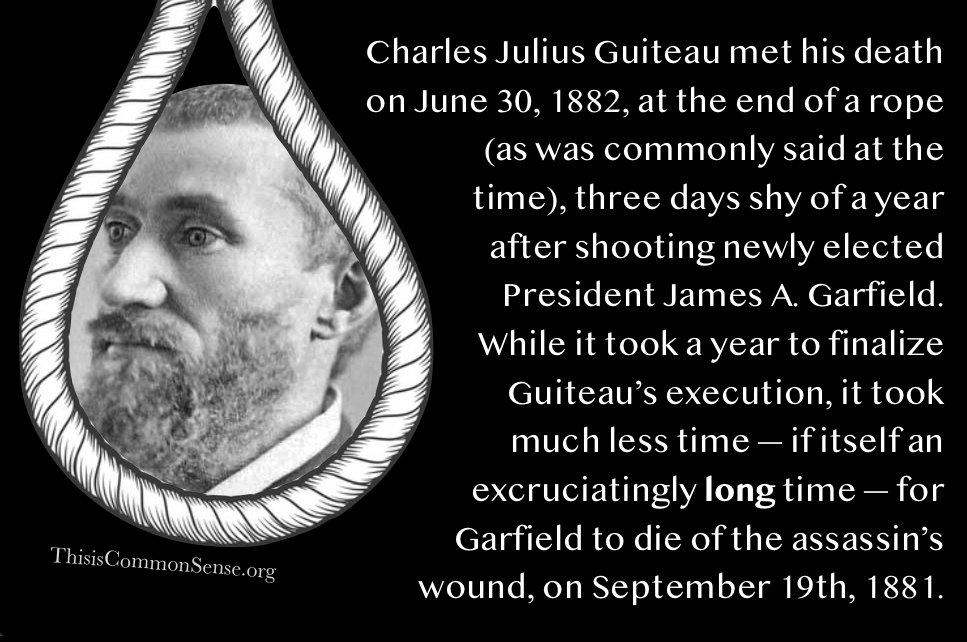
Charles Julius Guiteau met his death on June 30, 1882, at the end of a rope (as was commonly said at the time), three days shy of a year after shooting newly elected President James A. Garfield.
Guiteau was a member of the “Stalwart” faction of the Republican Party, devoted to the continuation of the kind of job-seeking corruption that Garfield, the reformer, opposed on principle. Despite being on the opposite team, so to speak, Guiteau was an ardent supporter of Garfield in the election campaign, and expected a diplomatic position in return. Failing to gain such a position in the new administration, Guiteau decided upon a sort of mad revenge as the apt response to Garfield’s “betrayal.”
While it took a year to finalize Guiteau’s execution, it took much less time — if itself an excruciatingly long time — for Garfield to die of the wound and the subsequent doctoring, on September 19th, 1881.