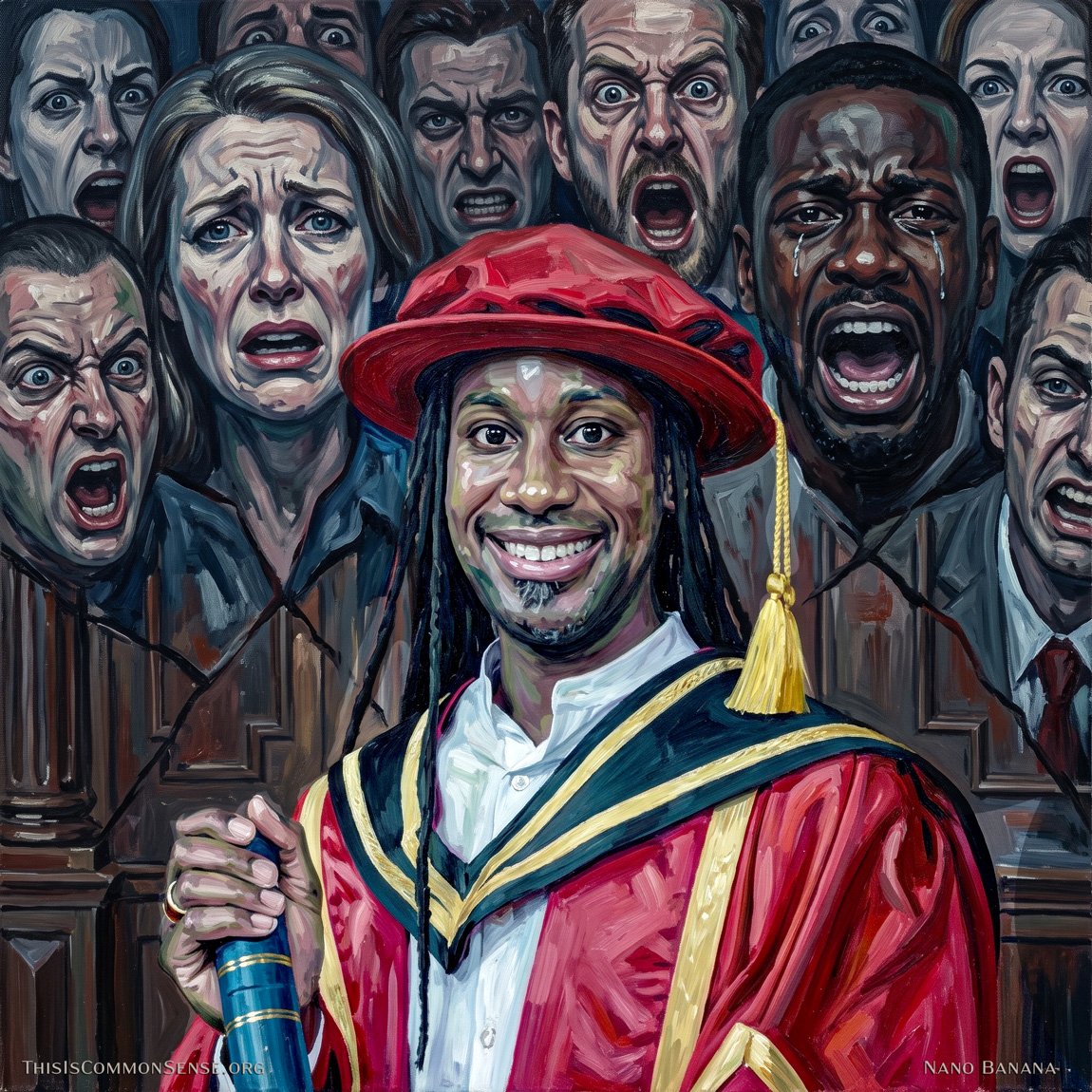
When did you first hear the story of Jason Arday?
In 2023, Mr. Arday became something of a public sensation in Great Britain, where his claims to being autistic, mute till age 11, and illiterate till 18 made a striking rag-to-riches/up-from-racism story upon his appointment as Professor of Sociology of Education at the University of Cambridge.
The youngest Black professor at that institution ever.
But few in America heard much about him.
Last September, Times Higher Education journalist Jack Grove documented what he alleged to be plagiarism in Arday’s 2015 PhD thesis and academic publications. Grove contacted Arday for comment; Arday responded with a letter from his lawyers. The story was not published.
Then, a month ago, philosopher Nathan Cofnas published his exposé, which began with a litany of Arday’s autobiographical whoppers, not including the one I heard most bandied-about: that at age 7 the young Jason had been interviewed for the famous documentary Seven Up! — a glaring fib because the movie came out 21 years before Prof. Arday
Cofnas compared passages in Arday’s 2018 paper to someone else’s 2012 paper. One sentence can serve to illustrate: “In particular, I seek to make a direct association between the tools of normative Whiteness and the deployment and consequences of racial microaggressions.” The italics indicate the one word Arday added.
A key contribution.
The Telegraph and The Times published stories on July 24th. On August 1, The Guardian got into it; four days later, the university opened an inquiry; the next day, Arday resigned.
Eight days later, Jason Arday was found dead in his apartment. Suicide? That’s what many surmise, but police have only said his death was “unexpected but is not believed to be suspicious.”
For some, a cause célèbre! Vigils, ongoing. But his mourners downplay the lies and plagiarism. It’s all about racism.
But whose? Could it be those who rushed to promote a man beyond his merit merely because of race?
This is Common Sense. I’m Paul Jacob.
Illustration created with Nano Banana
See all recent commentary
(simplified and organized)
See recent popular posts
3 replies on “A Scandal’s Arc”
If an academic lauded by libertarians, by conservatives, or by right-wing populists had proved to be as great a plagiarist and fabulist as was Mr Arday, and subsequently killed himself, then the mainstream of the media and the rest of the political left would be dancing on his corpse. But much of that mainstream has spoken and written as if the charges were as-yet unproved allegations, and those further to the left have ranted as if the evidence may be discounted or disregarded on a claim that those who presented it obviously have wicked hearts.
To face what went wrong in the case of Jason Arday, the left would have to face what is wrong with that which is perversely called “social justice”. Some of the left will not retreat from their commitment to this pseudo-justice, but none of the left can effect more than a Fabian withdrawal, unless they would cease to be the left.
So the left will be working to shape a narrative in which Mr Arday is most of all a victim, whose transgressions were few and minor. And any attempt to interfere with that fabulisation will be denounced as “ghoulish”.
Thanks to AI, PhD theses will soon be worth a dime a dozen.
Pat, right now, AI is steeply discounted, running on infusions of money from investors and not turning a profit. Eventually, investors will want a return on their investments, and what will follow will be a contraction of the industry and a rise in prices for AI services. (Though the relative prices of IT hardware should fall, as demand contracts for the factors of production of AI.)
Were the services of LLMs to remain indefinitely inexpensive and to continue to improve, then dissertations in academic disciplines characterized by cant might all be generated by AI.
But improvements in LLMs require better training data, but the marginal cost of better training data is exploding.
An improvement in AI sufficient to displace doctoral work in other fields would require the programmers themselves to have a formalized grasp of rational choice under uncertainty, including the logic of plausibility. Right now, very little attention is being paid to foundational questions in this area. Researchers try to use familiar mathematic tools to wing it, and fall silent when shown that essential difficulties require unfamiliar mathematic tools.
And, if-and-when such an AI is coded, it will have to be taught in a way very different from how an LLM is trained.
I have my doubts that production of such an AI will ever prove cost-effective.
But, even then, disciplines requiring field research would need extraordinary advancements in robotics for the dissertations to be automated.