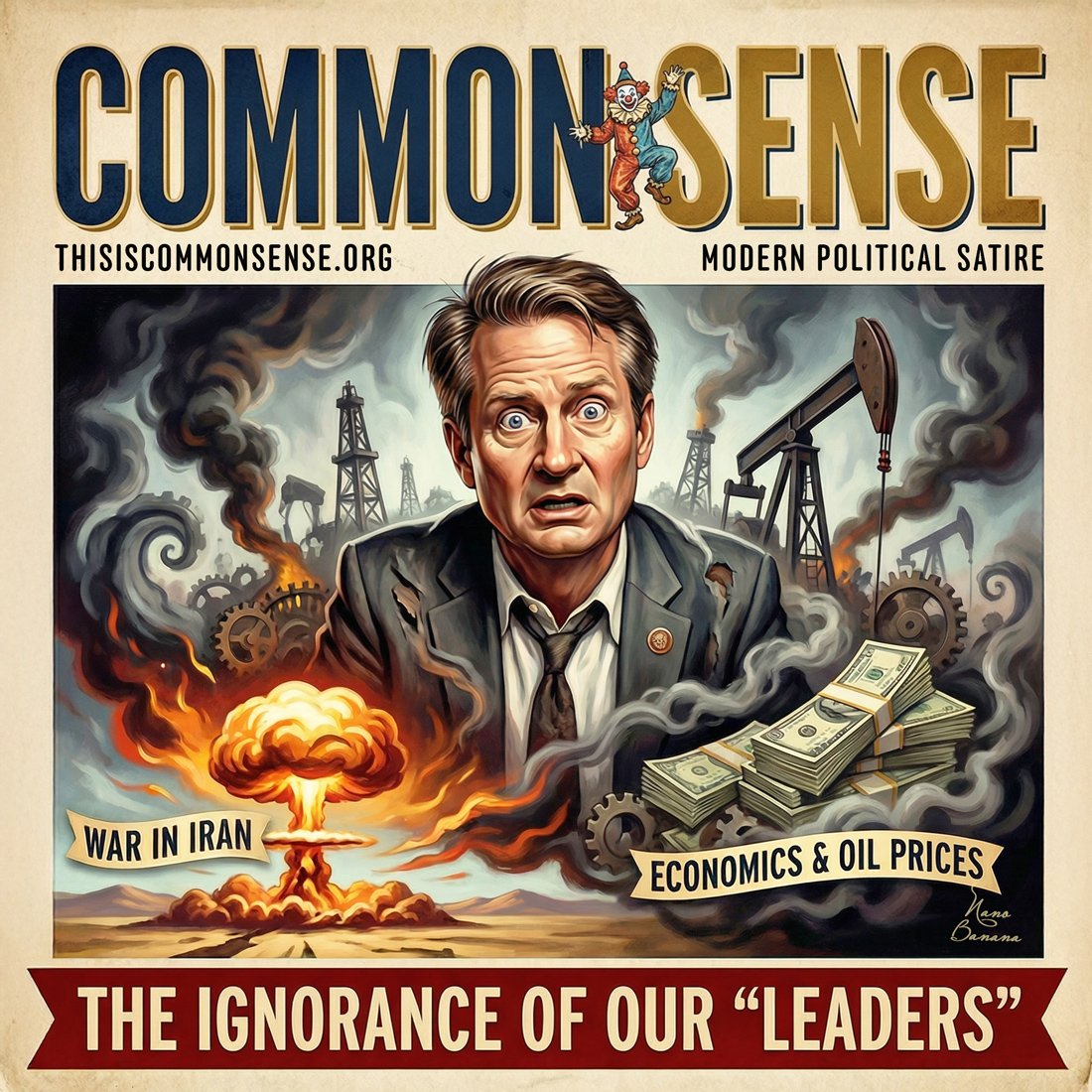
Tough times. You encounter a politician. He takes your side on an important issue. He speaks eloquently and with apparent sense. But then switch the subject and suddenly he blurts out such stupidities that you wonder about his sanity, the state of the nation’s education, the very meaning of life itself.
Well, not that last one.
Let’s turn the page in our anti-hymnal to Representative Tim Burchett (R.-Tenn.). I’ve quoted him. He’s given off detectable glimmers of hope. Yet now he (in the words of an enthusiastic twitterer) “exposes the price of gas increasing in America has nothing to do with the Iran war.”
But what does he say?
“How much oil does America get from Iran? Zero.”
True enough. But so what?
Our president’s un-declared war has resulted in conflagrations of oil wells and a cessation of petroleum transportation through the Strait of Hormuz. But while acid rain descends upon Iranians, it’s gas prices that concern Americans. And Burchett is disgusted.
“That’s how much this is a scam,” he said. “And these oil companies, shame on ’em. They’re using this opportunity to make record profits once again.”
We’ve heard this logic before.
“It’s greed!”
No, it isn’t. Sure, I’m no economist — but I understand that the market for petroleum products is a worldwide one, and if supply collapses on the other side of the world, it’s going to affect prices over here. We may not buy from Iran, but folks elsewhere do, and when they cannot get what they need, they’ll go to competitors, and world prices will be bid up.
To avoid this natural process, we’d have to simultaneously decrease demand. And how would Burchett do that?
The first casualty of a price hike is common sense.
Not here, though, for this is Common Sense. I’m Paul Jacob.
Illustration created with Nano Banana
See all recent commentary
(simplified and organized)
See recent popular posts
6 replies on “Stupid About Greed”
I don’t know to what extent Representative Burchett is yet another meat-puppet who doesn’t understand that would-be buyers around the world compete for petroleum extracted wherever it might be, and to what extent Burchett is knowingly running cover for the Trump Administration as one of the many costs of war is felt by American cosumers.
The autarkic temptation will surely rear its ugly head, with some insisting that America petroleum producers withdraw from the world market, to serve only American consumers, thereby removing foreign demand from the equation. The same people who will insist on this embargo are some of the people already outraged that the PRC is restricting sales of rare earths to those outside of China. And, still earlier, some of these same people were outraged when America faced petroleum embargoes in the ’70s during a time in which domestic production did not meet domestic demand.
Populists disdain logic and demands for consistency, except exactly where these can be weaponized against their opponents. Buying from Americans, not buying from Americans, selling to Americans, and not selling to Americans are each, in turn, framed as trespass.
Our DemoSocialist friends never worried about fuel prices while the Creepy Joe administration was driving them through the roof. But then, as is well documented. they are hypocrites.
Are you as dumb as your replies indicate?
Here is what happened to oil prices! Are you really this stupid?
“ After the COVID shutdowns ended and pent-up demand was used up, oil prices didn’t simply fall back to normal. Instead, they went through three different phases.
1. 2021–2022: Prices surged as the world reopened
When economies reopened, people suddenly:
• started driving and flying again
• restarted factories and shipping
• used more diesel, jet fuel, and gasoline
At the same time, production had been cut during the pandemic by the OPEC alliance and other producers.
So demand rose faster than supply, and prices jumped.
• U.S. benchmark West Texas Intermediate crude oil climbed from around $40 in 2020 to about $75 by the end of 2021. 
Then another shock happened.
⸻
2. 2022: The Ukraine war pushed prices even higher
When Russia invaded Ukraine in 2022, global oil markets feared supply disruptions.
• Prices briefly rose above $120 per barrel in mid-2022. 
Energy prices became one of the major drivers of global inflation that year.”
You shouldn’t comment if you know nothing about the subject!
Pam,
• 2WarAbnVet compared the reactions to the consequences of policy. The shut-downs didn’t just happen; they were policy. The war in Ukraine wasn’t exogenous; it was a consequence of policy, and the response to the Russian invasion was further policy.
• A statement such as “Energy prices became one of the major drivers of global inflation that year.” is simply a mindless regurgitation of balderdash. Price-inflation does not drive price-inflation.
• Cite your sources, instead of employing argumentum ex auctoritate non revelata.
• Tell whatever AI you are using to stop bloviating, to express itself efficiently.
• Use quotation marks properly.
In a world that is so interconnected, even a localized natural disaster such as a volcanic eruption or a hurricane can cause disruptions in the supply chain, leading to higher prices globally. No one can repeal the law of supply and demand. As a consumer, I am concerned with the diversity of our supply chains. Obviously, natural disasters cannot always be prevented. We need to plan for alternative sources in such cases. Tim Burchett is as shortsighted as the globalists who thought world trade would prevent or ameliorate conflict between nations. Not all nations share the same priorities or the same values as their current trading partners. We need to admit that and plan accordingly.