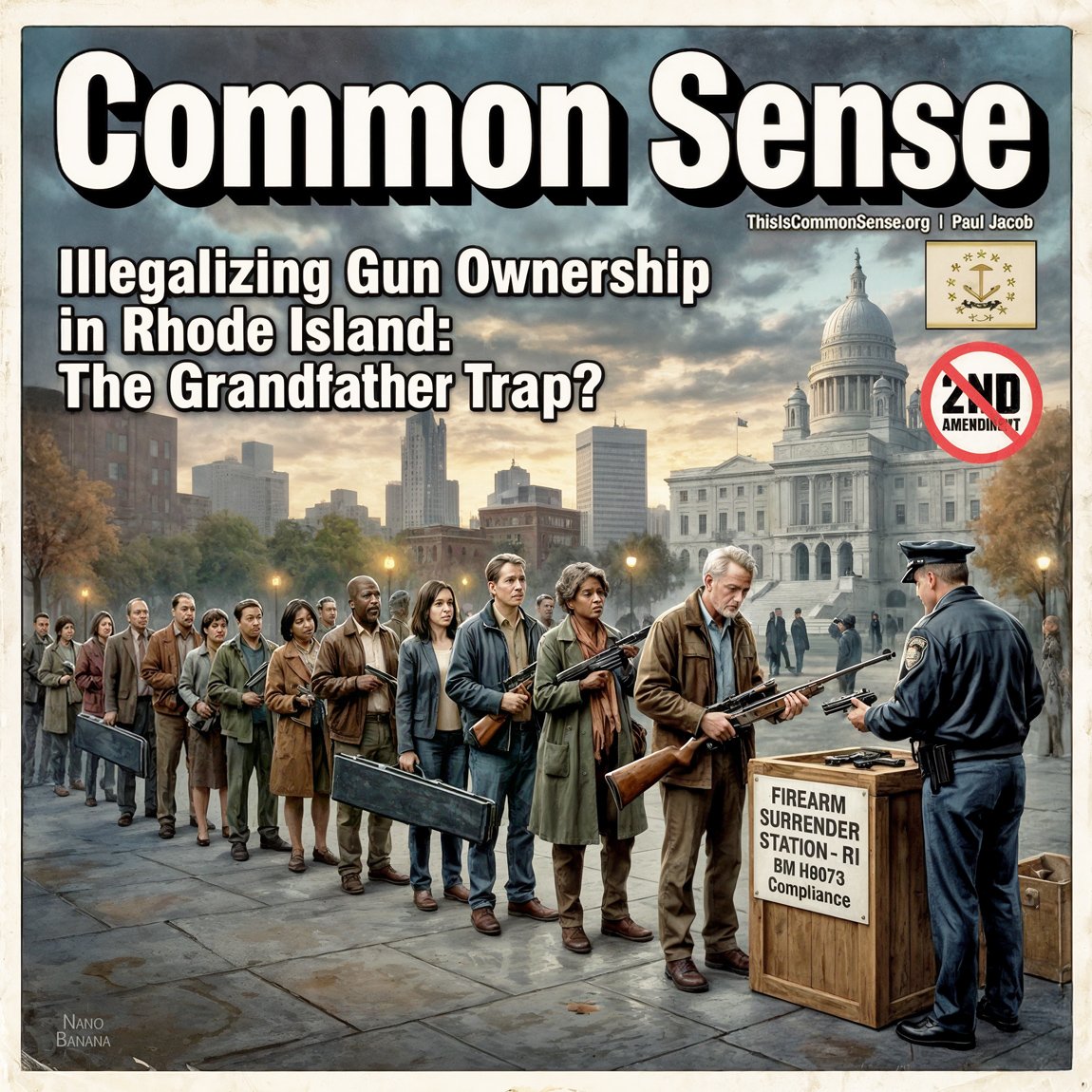
As a gun owner in Rhode Island, you may think that no matter what wacko state laws legislators impose to make it harder to buy weapons, at least you’ll remain secure in your right to the arms you’ve already legally purchased.
Not so. Bearing Arms alerts us to the fact that two bills pending in the state legislature jeopardize your right to keep your already owned — lawfully obtained— firearms. One bill does so immediately. The other paves the way for follow-up legislation that does so immediately.
H8073 “updates” a bill passed last year that banned the sale of “assault weapons” — a kind of weapon that is clearly the opposite of those used to soothe and caress. Current “assault weapon” owners were grandfathered in. Having bought their “assault weapons” when it was legal to do so, owners wouldn’t have to give them up.
But that was last year. Now, if H8073 becomes law, Rhode Islanders will have to turn in those weapons or face penalties like up to ten years in prison and a fine of up to $10,000.
Looking at the bill, you see a reference to restrictions on “manufacture, sale, and purchase of prohibited firearms” crossed out and replaced by reference to restrictions on “manufacture, sale, possession, and purchase” of same. Just a quick fix.
Another bill, H7755, would impose onerous training-certificate and waiting-period requirements for new handgun purchases. You would not need to comply to keep handguns you already have . . . unless the wording is ever changed.
This is Common Sense. I’m Paul Jacob.
Illustration created with Nano Banana
See all recent commentary
(simplified and organized)
See recent popular posts
5 replies on “The Island of Dispossessed Guns”
The purpose in passing laws and in pursuing convictions that the Democrats fully expect to be rejected by the courts at some stage in the appeals process is simply to impose great costs upon their opponents, even as taxpayers bear the costs of such perverse pursuits.
On top of freeing ourselves from the doctrine of qualified immunity, we need to be freed of any principle that legislators, police, prosecutors, or judges can, without more than mere reputational damage, ever impose or ever enforce laws or rulings that are so plainly unconstitutional.
Let’s see how many gun owners and 2A advocates are prepared to leave Rhode Island and find a more hospitable locale in which to live. The alternative is to vote out those who would limit your rights under the Constitution.
Good riddance if you want to move out of the state. I think Rhode Island likes being small.
Virginia says “Hold my beer”.
“Come and take them.”