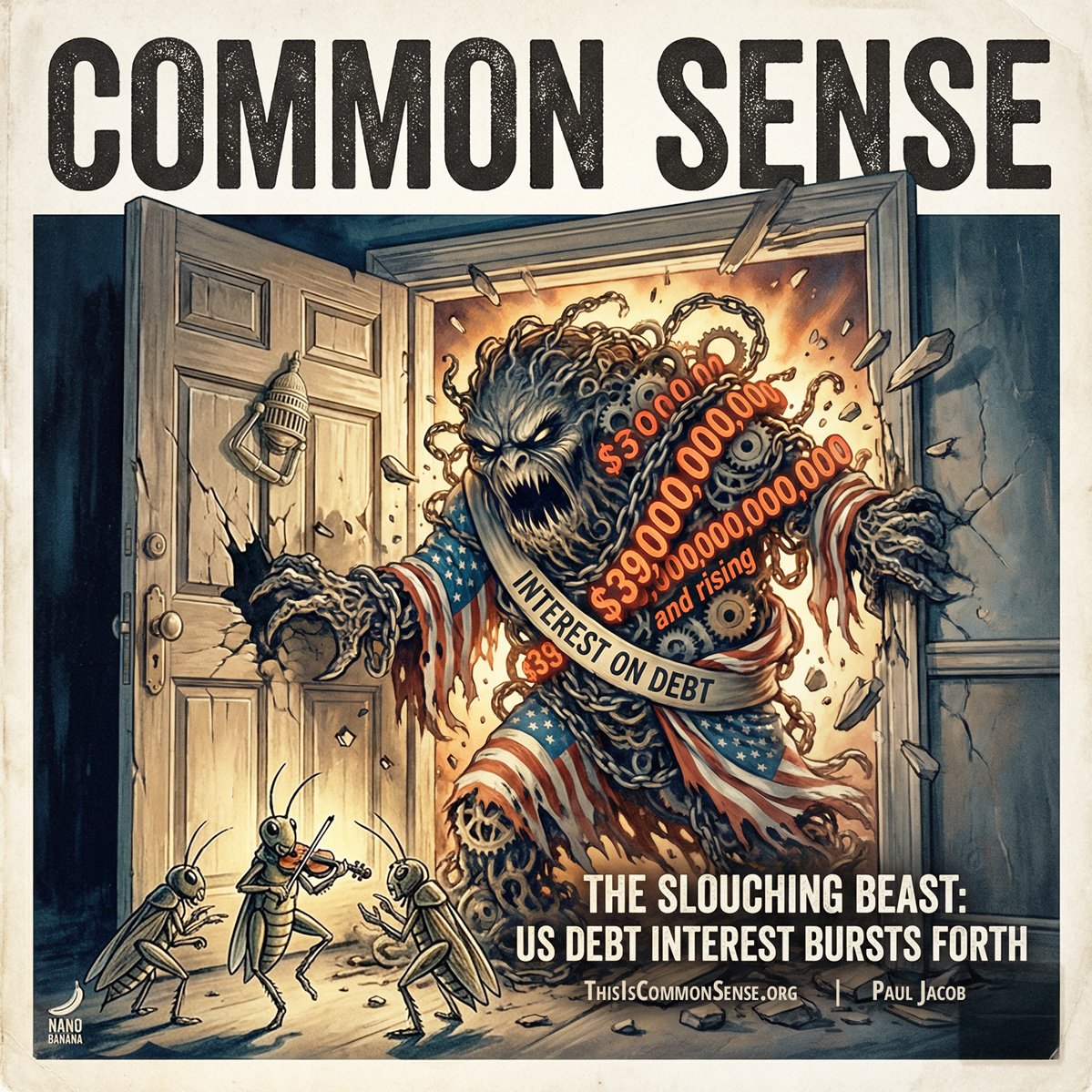
As the U.S. Debt Clock ticks towards $39 trillion, a predictable but horrible beast slouches towards us, ready to knock on the door. Or, rather, burst through.
The federal debt hit $38.8 trillion this weekend: it’s $38,830,051,666,666 as I type these words on Sunday.
But that’s not the beast.
This year’s annual deficit is $1.9 trillion.
But that’s still not the beast.
The Congressional Budget Office warns that the debt-to-GDP hits 120% by 2036 — above post-WWII peak.
That isn’t the beast either.
The beast is the interest on the debt, and the service charge the government must regularly make merely to keep the borrowing going.
Net interest payments will be over one trillion smackeroos this fiscal year. That rivals or exceeds spending on defense/veterans in many breakdowns — those payments are projected to double to over two trillion per year by 2036.
It’s the fastest-growing line item.
It’s non-discretionary.
And it compounds; the beast only gets bigger.
And with it any hope for tax relief goes out the window. Just last week the president, reacting to the Supreme Court decision in Learning Resources v. Trump, floated what amounts to a revenue-directed tariff, and under normal circumstances voters could not unreasonably demand, say, an offsetting 15 percent reduction in income taxes, across the board.
Nothing like that is in the offing. Not because tax cuts wouldn’t be a big win for the tariffer-in-chief, but because any extra revenue might be more cost-effectively thrown as debt service at the American holders of $31 trillion in federal debt.
This is as bipartisan an issue — and failure — as anything can be, yet the bipartisan response?
Crickets.
This is Common Sense. I’m Paul Jacob.
Illustration created with Nano Banana
See all recent commentary
(simplified and organized)
See recent popular posts
One reply on “The Beast Cometh”
The Congress will stop passing unbalanced budgets when it can no longer borrow.
By the way, lest anyone chirp happily about the budget supposedly having been balanced under Clinton, let’s note that Social Security pension benefits were made “off-budget” in the 1980s. The last time that the federal budget was genuinely balanced was 1969; it was not, however, generally balanced until then.