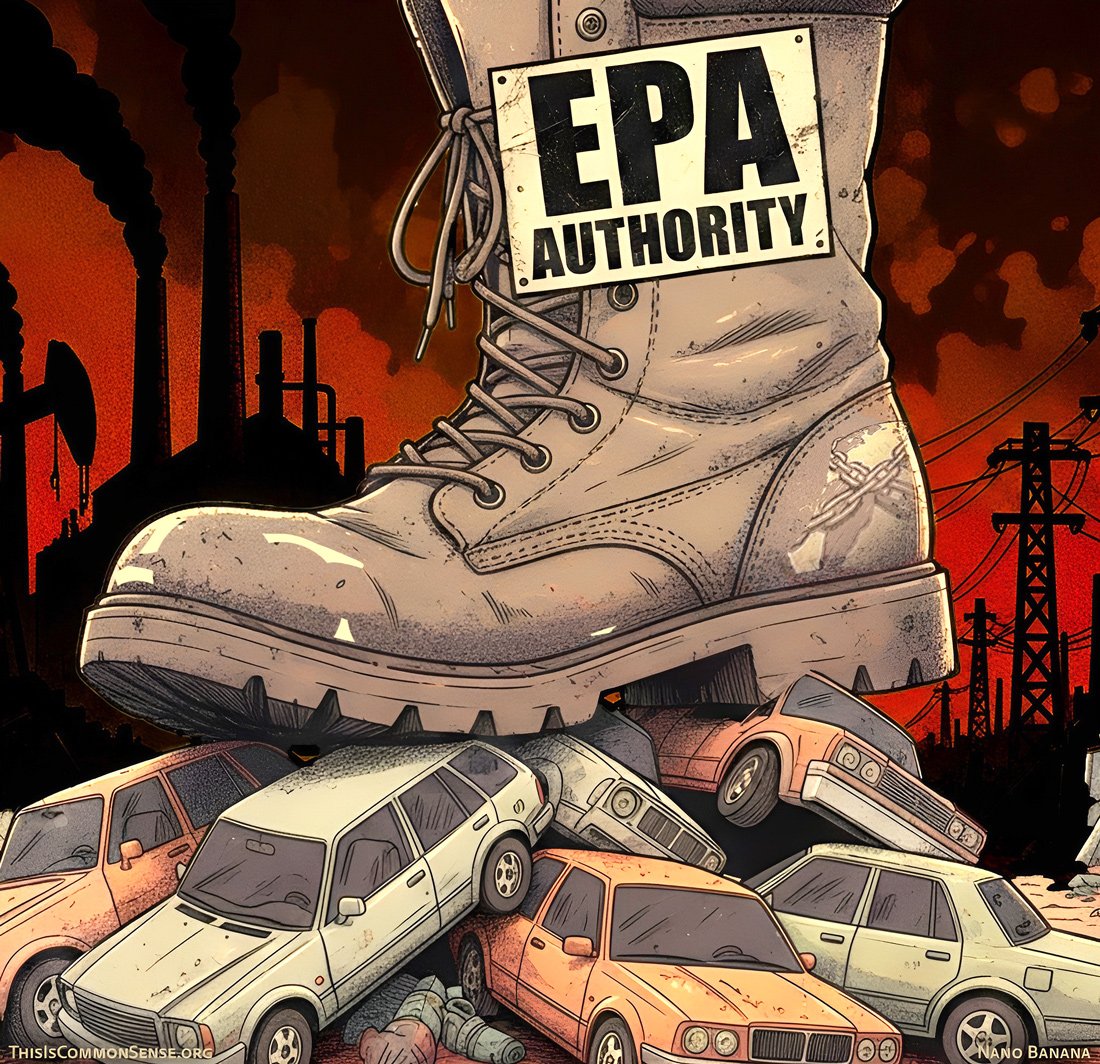
In 2009, President Obama and the EPA decided that the will-o’-the-wisp of fine-tuning the amount of greenhouse gases in the atmosphere fell under the agency’s purview. They introduced a not-so-thin wedge to pry open a vast new province of regulatory oppression.
Obama had sought congressional legislation, but Congress had balked.
So he proceeded without any new laws; or rather, as so often happens, told an agency to issue new laws. (According to one explanation of the difference between laws and regulations, regulations are rules to implement laws. This doesn’t cover the case of regulations or “findings” that are tantamount to new laws although no elected representatives passed them.)
“Health” was at stake, the tyrants declared.
The flourishing of industrial civilization, and thus of human beings, are also matters of health. But no matter.
One consequence of the EPA’s newfound authority was the issuance of other dire “rules,” like the Biden-era mandate that most American-made vehicles be electric by 2032.
Now things may change.
Bigly.
President Trump has ordered the EPA to un-find its 2009 “finding” that it has blanket authority to regulate human emission of greenhouse gases.
The change will be challenged in court.
The Trump administration doubtless expects — perhaps even wants — the litigation. A favorable Supreme Court ruling would block the EPA from re-finding its finding during future administrations. Then legislation — actual, congressional — would be the only way to reimpose the craziness.
A circumstance in which the people might have a say.
This is Common Sense. I’m Paul Jacob.
Illustration created with Nano Banana
See all recent commentary
(simplified and organized)
See recent popular posts
6 replies on “A Great Un-Finding”
The pending case on tariffs might — just might — set in motion a process that will bring an end to the administrative state. Congress has attempted to delegate much of its essential responsibilities to the executive branch. This delegation has allowed the President to set tariff rates and to begin wars, and has allowed “progressives” to create technocratic regulatory agencies that create law and to determine internal taxes.
But, in the absence of a mechanism under which Congress could, without hindrance, rescind delegation, the delegation amounts to a amending of the Constitution on the authority of Congress and the President. And the Constitution did not provide such a mechanism, as the President can, by himself, veto rescinding legislation.
A simple question by Justice Gorsuch demonstrated that he is aware of this fatal flaw in the theory under which Congress delegated its power to set tariffs. The same flaw undermines any theory that the Congress can delegate law-making authority.
I suspect that the current delay in delivery of a decision on tariffs is because the Justices are in three blocs. One, a group of Constitutionalists, propose to craft and deliver a monumental ruling. Another, a group of Cowards, not only want to avoid anything so radical, but don’t even want a minority opinion to expose the fatal flaw in the theory of delegation. Finally, the Democrats want somehow to oppose Trump on tariffs, but to preserve the administrative state.
Really? And your head is where?
“The United States Department of Defense has repeatedly described climate change as a “threat multiplier.”
That means climate change:
• Makes existing conflicts worse
• Destabilizes vulnerable regions
• Increases humanitarian crises
• Creates new operational challenges
It’s not framed as “the biggest threat,” but as something that intensifies other threats.
⸻
🧭 Why the Military Cares
1️⃣ Base & Infrastructure Risk
Hundreds of U.S. military installations are vulnerable to:
• Sea-level rise (e.g., Naval Station Norfolk flooding)
• Stronger hurricanes
• Wildfires in the western U.S.
• Permafrost thaw in Alaska”
Pam, if you’re going to quote some supposèd authority then you need to cite the authority, and if you are going to quote multiple paragraphs and passages that themselves use quotation marks then you need to learn how such quotation is done in the English language.
In any case, you are simply repeating a dogma that has a predictive track-record characterized more by failure than by success, and with no successes peculiar to that doctrine. Most of us here are not moved by what amount to religious proclamations.
A favorable Supreme Court ruling may not be a permanent block on the EPA. A future court, with new or additional members, may revisit the case and reverse itself. It’s happened before – in 1954 with Brown overturning Plessy.
Pat, a Congress that would consent to appointment of Justices who would empower the EPA again to legislate would likely first pass laws embracing the pseudo-science of AGCC.
The US Supreme Court occasionally rules legislation to be unconstitutional for being plum crazy, but not often. And if the Congress were to pass such a law with acquiescence of the President or over-riding a veto, the Supreme Court would be very unlikely to rule the law unconstitutional even without a change in the present composition of the Court.
Still no pics or headlines when linking an article to FB!