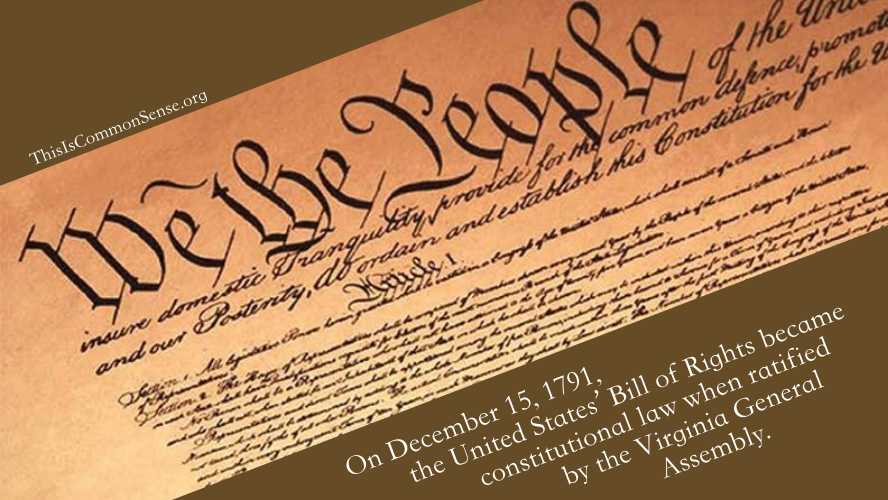
On December 15, 1791, the United States’ Bill of Rights became constitutional law when ratified by the Virginia General Assembly.
On December 15 in 1933, the Twenty-first Amendment to the United States Constitution officially became effective, repealing the Eighteenth Amendment that had, by enabling the Volstead Act, prohibited the sale, manufacture, and transportation of alcohol for any other than medical and industrial uses.
December 15 birthdays include that of Pehr Evind Svinhufvud af Qvalstad, 1861, first Head of State of independent Finland, serving in this capacity first as leader of the Senate and then as Protector, or Regent. In 1930 he became Prime Minister, and in 1931 was elected President, leaving office in 1937.
During the Civil War of 1918, his anti-socialist refugee government, Valkoiset, or “Whites,” opposed the “Reds,” a Social Democrat Party faction, for control of the government as it transitioned from Russian rule as a Grand Duchy, to independent status.
He died in 1944.
One reply on “Bill of Rights Became Law”
What is called “The Twenty-First Amendment” is problematic.
Its first section reads “The eighteenth article of amendment to the Constitution of the United States is hereby repealed.” The lack of capitalization strongly suggests that “The eighteenth article of amendment to the Constitution of the United States” is a description, rather than a name.
What is normally regarded as the seventeenth Amendment could not have been adopted, because Article V of the Constitution, which provides for Amendments, prohibits any Amendment stripping the states of representation in the Senate.
And that, in turn, implies that what is normally regarded as the eightteenth Amendment was actually the seventeenth, and so forth. In which case, what is taken to be the nineteenth Amendment was actually the eightteenth.
At least half of the country would be outraged if what is commonly called “The Nineteenth Amendment” were found to have been repealed by sloppiness in the wording of has been taken to be the twenty-first. And I remind everyone that the British suffragettes sometimes engaged in terrorism.