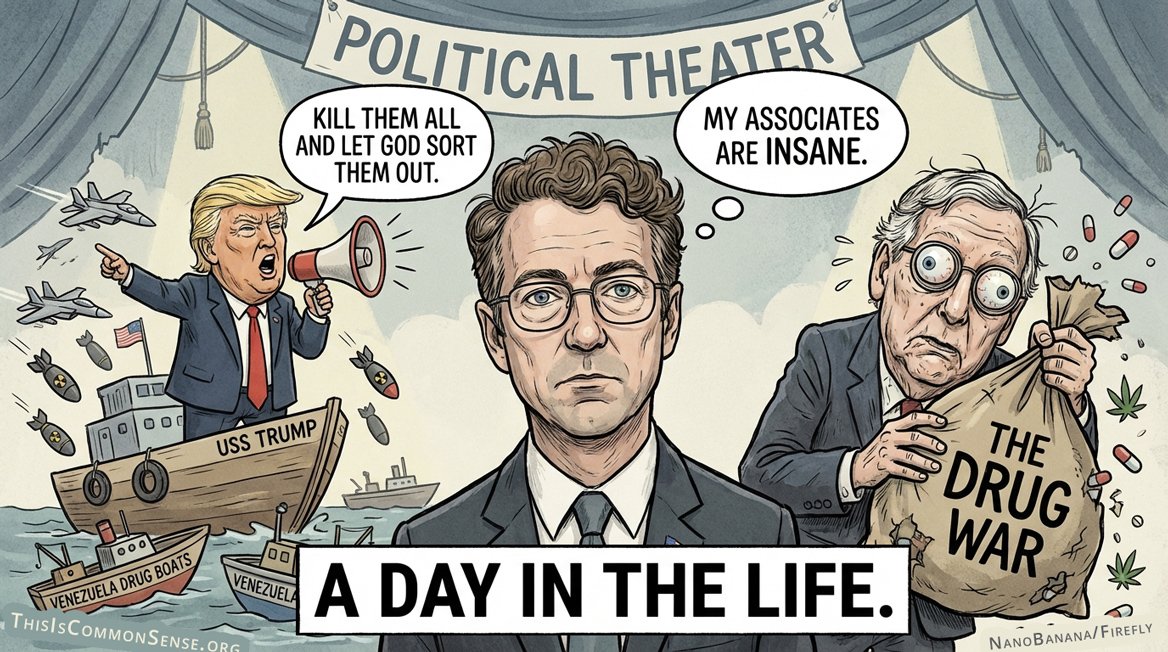
The Trump Administration is at war . . . with Senator Rand Paul.
Tensions between the President and Senator Paul have heated up noticeably since mid-October, with Trump taking sharp public swipes at Paul, a longtime ally. This scuffle seems primarily driven by Paul’s outspoken criticism of the Venezuelan boat strikes, which Trump sees as a betrayal of his “tough on drugs” agenda and a threat to GOP unity.
The budget hawk angle — mentioned here in a weekend update — is a secondary irritant, tied to Paul’s broader push for fiscal restraint. But it hasn’t dominated the feud.
While Trump decries a lack of unity, Paul offers Trump’s bellicosity as “detrimental to the party.”
Against the Kentucky senator’s war-powers/war-crimes critiques, the president is acerbic: “Rand wants trials for narco-terrorists 2,000 miles away? Tell that to the fentanyl orphans.”
Tough zinger, sure, but think about it: it’s the standard argument against all civil liberties. The idea that those suspected by the government of awful crimes, even lacking any proof or semblance of due process, do not deserve rights.
Leading to a modern adaptation of “Kill them all and let God sort them out” in the Carribean.
Meanwhile, in a bizarre reversal of the ongoing marijuana legalization and hemp deregulation trend, the federal government has “turned back the clock”: Tucked into the continuing resolution (CR) that ended the 43-day government shutdown, Congress passed (and Mr. Trump signed) language that effectively bans most hemp-derived products containing more than 0.4 milligrams of THC per container — a threshold so low it sweeps up even basic CBD items, which naturally contain trace THC.
Since Kentucky sports over 5000 acres devoted to the ancient industrial product, you might suspect that this could be part of Trump’s war on Kentucky’s junior senator.
But it appears the state’s senior senator was behind the move!
New War on Drugs, meet the old War on Drugs.
This is Common Sense. I’m Paul Jacob.
Illustration created with NanoBanana and Firefly
See all recent commentary
(simplified and organized)
See recent popular posts
3 replies on “The War on Drugs War”
In 2008, the Republican Party was so terribly wrecked by the consequences of neo-conservative foreign and fiscal policies that it seemed that it might never recover. But the Tea Party arose; and, while it failed to capture the Republican Party, the Tea Party showed that the Republican Party weren’t simply a vehicle for neo-conservatism, and reëngaged many voters who had been alienated by neo-conservatism. The establishment Republicans who were able to hold-off the Tea Party were far less able to hold-off Trump in 2016, and a fair share of them were driven from the Republican Party by Trump 2.0 in 2024. Now Trump 2.0 seems to be steering a course that will once again bring ruin to the Republican Party. But Senator Paul and Representative Massie may perhaps show that the choice isn’t necessarily between authoritarian right-wing populism and whatever flavor of totalitarianism the Democrats offer.
I would like to know what it really happening in the undeclared war with the Venezuelan state. Plainly, the speedboats and submarines are not transporting fentanyl to America; but plainly the speedboats and submarines are not fishing vehicles either. If they were not being used for some purpose both important and time-critical, then the appropriate response of whoever is employing them would be to lay-low for a while, and thus to make the US Naval deployment seem to be bare and expensive imperialism.
Mitch McConnell seems about as much a zombie as was Joe Biden; and, rather than seeing him as behind the new limit on THC, we should look at the people behind him. These included the Attorneys General of most (39) of the constituent states, associations of narcotic officers (committed to the idea that narcotics should be policed), producers of alcohol (a rival intoxicant), sellers of cannabis in regulated dispensaries trying to limit competition, and old-fashioned prohibitionists.
Monica Showalter offered a different view of those speedboats. Like other countries, Venezuela’s sovereignty extends twelve miles from the shore. Once past that barrier, ships are in international waters. Ships in international waters are expected to fly the flag of their jurisdiction. These boats fly no flag. That gives Venezuela plausible deniability. It also suggests a declaration of war is not necessary. Since they fly no flag they are the modern day equivalent of pirate ships. Her argument is there is not a war crime because s flagless carrier, under international law, is a pirate ship. The US military has a storied history of fighting pirates.
As far as this old Army Ranger is concerned, overkill is underrated.