Categories
Today

Planets & Moons & More

1781 — William Herschel discovered Uranus.
1809 — Sweden’s King Gustav IV Adolf was deposed in the Coup of 1809, a political result of the disastrous Finnish War with the Russian Empire.
1814 — The Congress of Vienna declared Napoleon an outlaw following his escape from Elba.
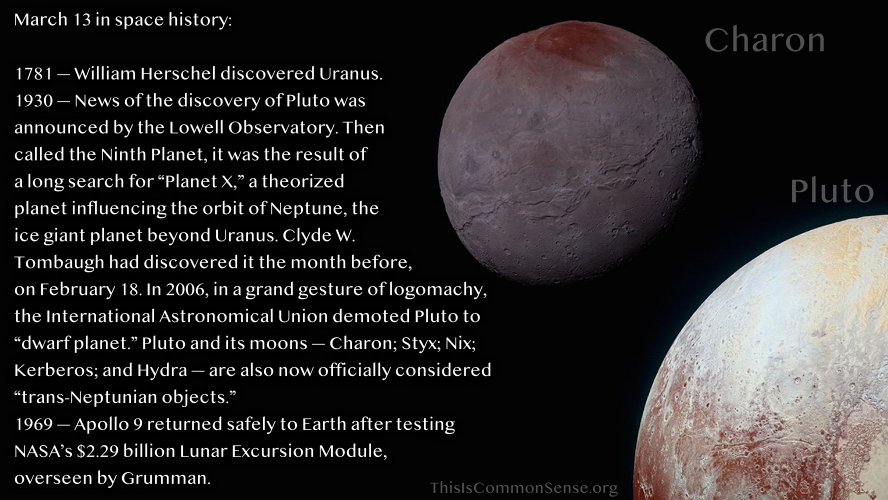
1930 — News of the discovery of Pluto was announced by the Lowell Observatory. Then called the Ninth Planet, it was the result of a long search for “Planet X,” a theorized planet influencing the orbit of Neptune, the ice giant planet beyond Uranus. Clyde W. Tombaugh had discovered it the month before, on February 18. In 2006, in a grand gesture of logomachy, the International Astronomical Union demoted Pluto to “dwarf planet.” Pluto and its moons — Charon; Styx; Nix; Kerberos; and Hydra — are also now officially considered “trans-Neptunian objects.”
1969 — Apollo 9 returned safely to Earth after testing NASA’s $2.29 billion Lunar Excursion Module, overseen by Grumman.

Categories
Today

Protest Worth Its Salt

Mahatma Gandhi began the Salt March, a 200-mile march to the sea, to protest the British monopoly on salt in India, on March 12, 1930.

Categories
Today

Shaken, Sworn In

March 11, 2010 — minutes before being sworn in as President of Chile, economist and businessman Sebastián Piñera is shaken as an earthquake hits central Chile and aftershocks disturb the ceremony.

Categories
Today

The Mahatma

On March 10, 1922, Mohandas Karamchand Gandhi (1869-1948), activist and theorist of non-violent revolution, was arrested in India, tried for sedition, and sentenced to six years in prison, only to be released nearly two years later for an appendicitis operation.

Categories
Today

Adam Smith

On March 9, 1776, Scottish philosopher Adam Smith published An Inquiry into the Nature and Causes of the Wealth of Nations, which became the first widely accepted landmark work in the field of economics.

The Wealth of Nations (as it is usually cited) was not the first general treatise on the subject, however; that designation almost certainly belongs to banker Richard Cantillon’s Essai sur la Nature du Commerce en Général, cited by Smith in his more famous book. It is also worth noting that Étienne Bonnot de Condillac’s systematic treatise, Le Commerce et le Gouvernement, also saw publication in 1776.

Categories
Today

Slavery/Anti-Slavery

On March 8, 1775, “African Slavery In America,” often described as the first known essay advocating the abolition of slavery in America, was published anonymously in the Pennsylvania Journal and the Weekly Advertiser. Thomas Paine is believed to be the essay’s author.

The first anti-slavery society was formed in Philadelphia weeks after publication, and Paine was a founding member.

Exactly 120 years earlier, a court in Northampton County of the Virginia Colony ruled that John Casor, then working as an indentured servant to Robert Palmer, must be returned to Anthony Johnson as Johnson’s “lawful” slave for life. Johnson himself was one of the original indentured servants brought to Jamestown, had completed his indenture to become a “free Negro,” and became the first African landowner in the colony. The case marked the first person of African descent to be legally recognized as a lifelong slave in England’s North American colonies. In summary: the first official chattel slave in English-speaking North America was of African descent was owned by a man also of African descent.

Categories
Today

The First American Bicameral

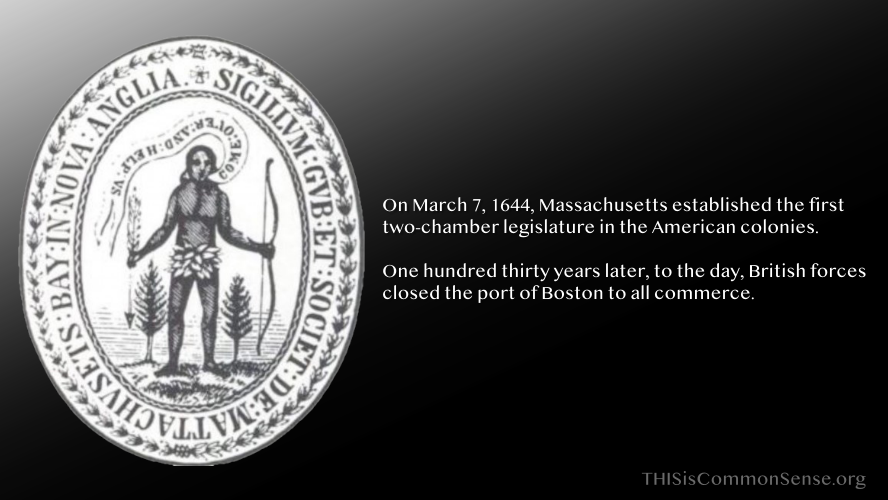
On March 7, 1644, Massachusetts established the first two-chamber legislature in the American colonies.

One hundred thirty years later, to the day, British forces closed the port of Boston to all commerce.

Categories
Today

Stalin’s Daughter Defected

On March 6, 1967, Soviet Premiere Joseph Stalin’s only daughter, Svetlana Alliluyeva (February 28, 1926 – November 22, 2011), defected to the United States. She later took the name Lana Peters, upon marriage to William Wesley Peters. The marriage was short-lived.

The March 6 date also marks term limits advocate and initiative organizer Paul Jacob’s birthday. He was born on the anniversary of the births of Michaelangelo, Cryano de Bergerac, and Alan Greenspan. He is also, obviously, the main reason that this site, ThisIsCommonSense.org, exists.

Categories
Today

Indexed!

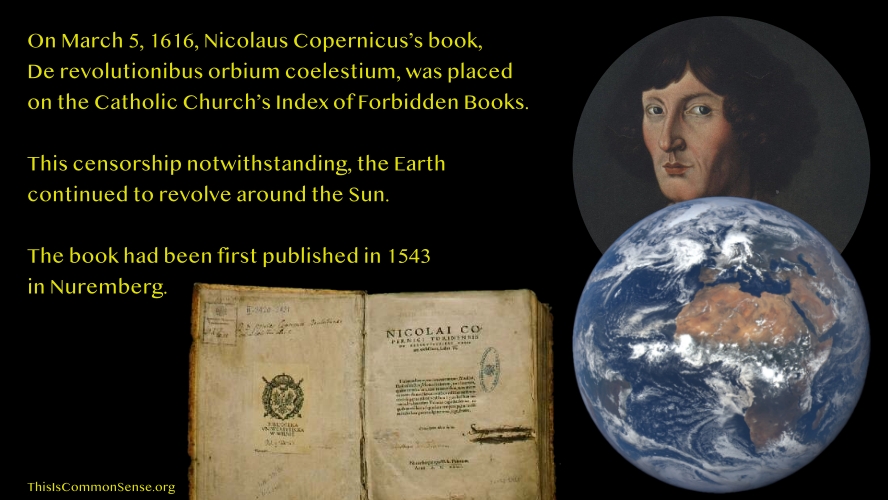
On March 5, 1616, Nicolaus Copernicus’s book, De revolutionibus orbium coelestium, was placed on the Catholic Church’s Index of Forbidden Books.

This censorship notwithstanding, the Earth continued to revolve around the Sun.

The book had been first published in 1543 in Nuremberg.


| In 1770, the Boston Massacre took place on March 5.

| Joseph Stalin, the longest serving leader of the Soviet Union, died at his Volynskoe dacha in Moscow on this date in 1953, after a cerebral hemorrhage.

| March 5 is magician Penn Jillette’s birthday.

Categories
Today

FDR Praised in Italy

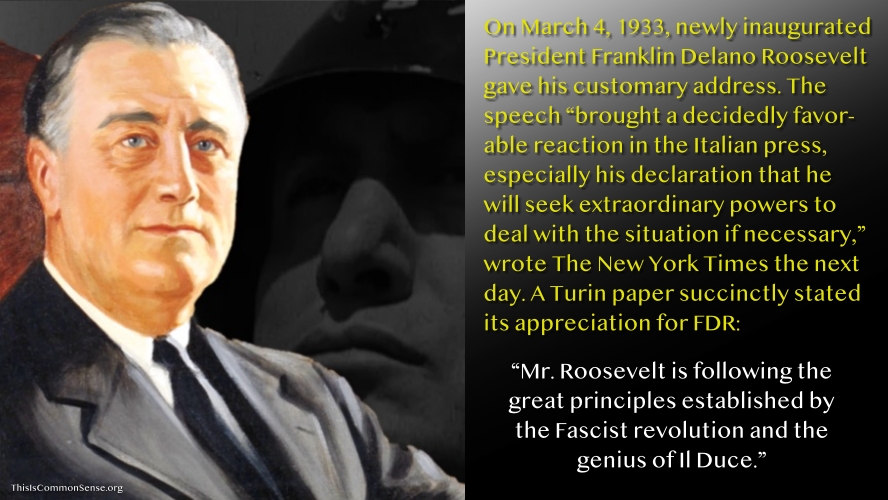
On March 4, 1933, newly inaugurated President Franklin Delano Roosevelt gave his customary address. The speech “brought a decidedly favorable reaction in the Italian press, especially his declaration that he will seek extraordinary powers to deal with the situation if necessary,” wrote The New York Times the next day. The Times went on to quote “Premier Mussolini’s Milan newspaper, Popolo d’Italia,” which stated that “The American people place their hope in decisive action by the new President and his speech truly satisfied public opinion.”

The Italian newspaper “said the bank moratorium in New York contributed perhaps more than any other factor in convincing even the most reluctant of the urgent necessity for the whole nation to rally around Mr. Roosevelt.” A Turin paper succinctly stated its appreciation for FDR: “Mr. Roosevelt is following the great principles established by the Fascist revolution and the genius of Il Duce.”


On March 4, 1789, the first bicameral Congress of the United States met in New York, New York, in accordance with the new Constitution.

Two years later on the same date, Vermont was admitted as the fourteenth state of the union.

In a twist in World War II allegiances, Finland declared war on Nazi Germany on March 4, 1945, beginning the Lapland War.