Mary Wollstonecraft, A Vindication of the Rights of Men (1790).
No man chooses evil because it is evil; he only mistakes it for happiness, the good he seeks.
Categories
Mary Wollstonecraft
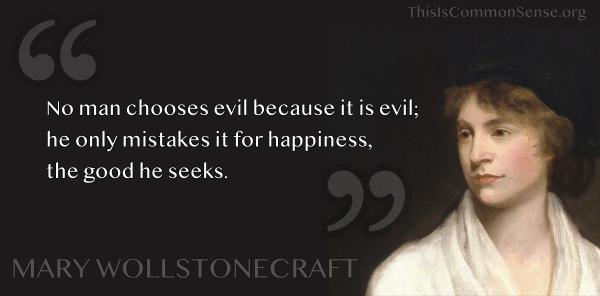
Mary Wollstonecraft, A Vindication of the Rights of Men (1790).
No man chooses evil because it is evil; he only mistakes it for happiness, the good he seeks.
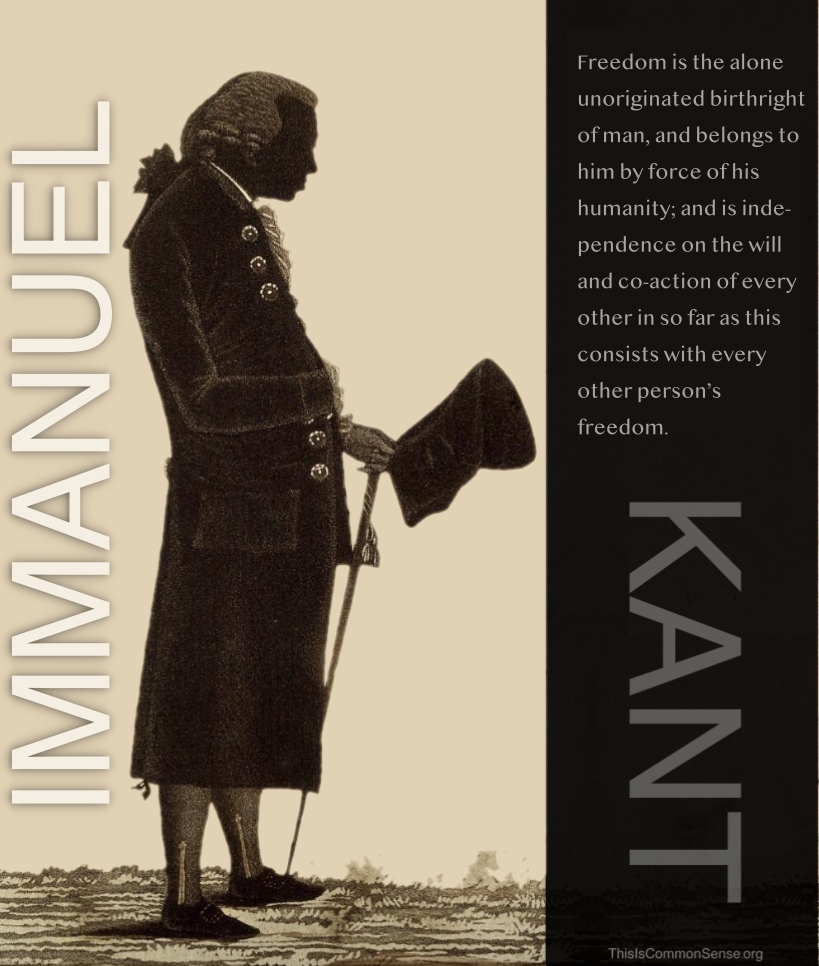
Freedom is the alone unoriginated birthright of man, and belongs to him by force of his humanity; and is independence on the will and co-action of every other in so far as this consists with every other person’s freedom.
Immanuel Kant, The Metaphysics of Ethics, trans. J.W. Semple, ed. with Iintroduction by Rev. Henry Calderwood (Edinburgh: T. & T. Clark, 1886) (3rd edition).
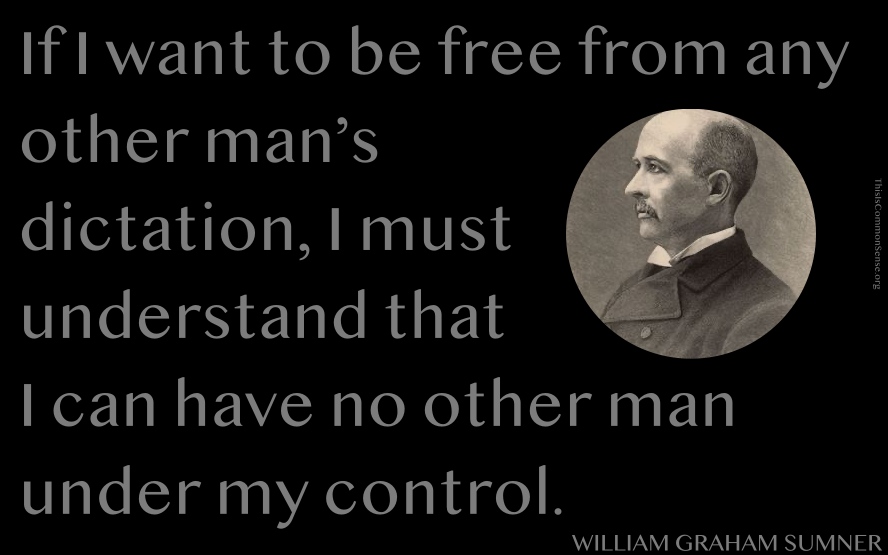
If I want to be free from any other man’s dictation, I must understand that I can have no other man under my control.
William Graham Sumner, “The Forgotten Man” (1883).
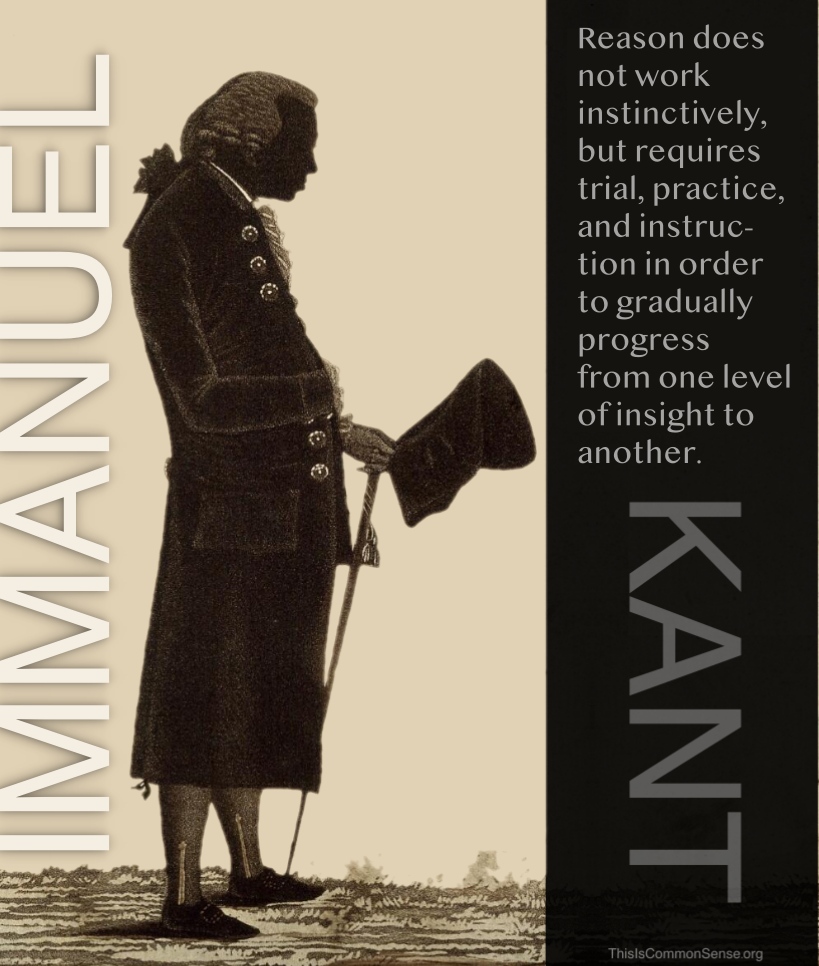
Reason does not work instinctively, but requires trial, practice, and instruction in order to gradually progress from one level of insight to another.
Immanuel Kant, “Idea for a Universal History with a Cosmopolitan Purpose,” 1784.
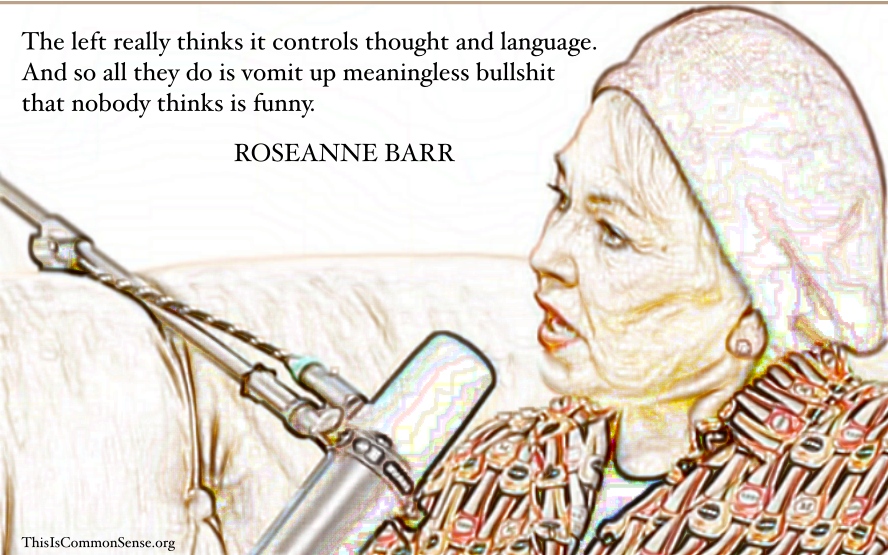
The left really thinks it controls thought and language. And so all they do is vomit up meaningless bullshit that nobody thinks is funny.
Roseanne Barr, on her podcast, explaining to Greg Gutfeld why leftists are no longer the good comedians.
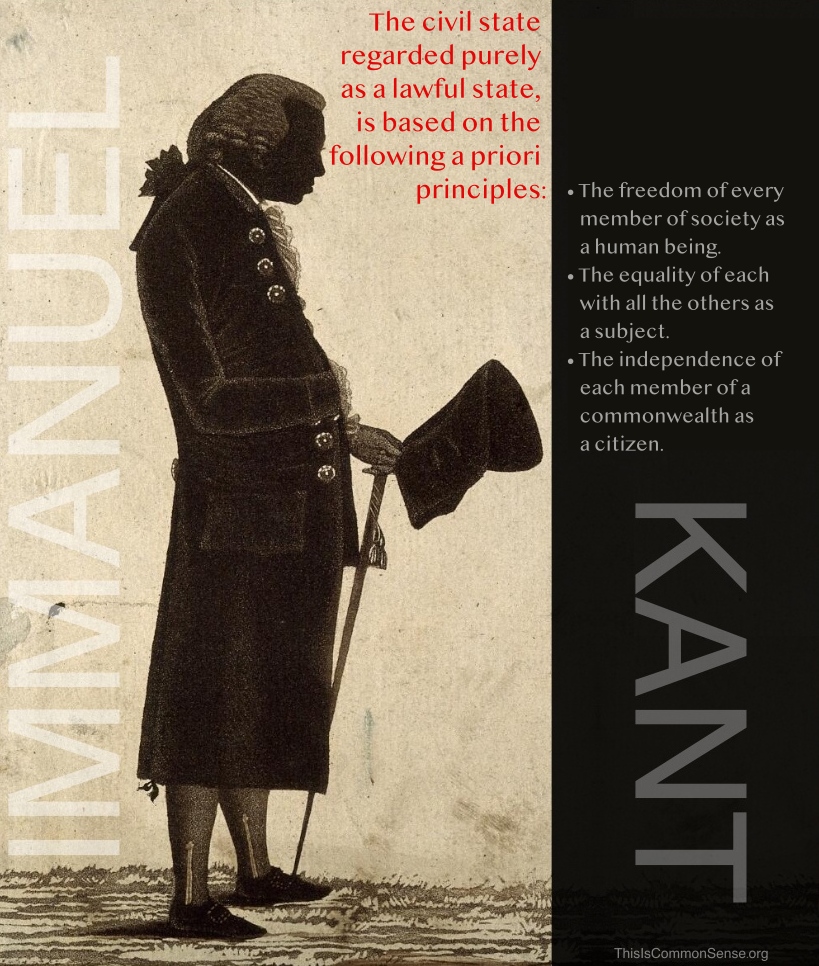
The civil state regarded purely as a lawful state, is based on the following a priori principles:
• The freedom of every member of society as a human being.
• The equality of each with all the others as a subject.
• The independence of each member of a commonwealth as a citizen.These principles are not so much laws given by an already established state, as laws by which a state can alone be established in accordance with pure rational principles of external human right.
Immanuel Kant, Theory and Practice (1791).
You can’t crush ideas by suppressing them. You can only crush them by ignoring them. By refusing to think, refusing to change. And that’s precisely what our society is doing!
Ursula K. Le Guin, The Dispossessed (1974), Chapter 6.
Coercion is the least efficient means of obtaining order.
Ursula K. Le Guin, The Dispossessed (1974), Chapter 5.
Certain ills belong to the hardships of human life. They are natural. They are part of the struggle with Nature for existence. We cannot blame our fellow-men for our share of these. My neighbor and I are both struggling to free ourselves from these ills. The fact that my neighbor has succeeded in this struggle better than I constitutes no grievance for me.
William Graham Sumner, What Social Classes Owe to Each Other (1883).
It is not the difference in taste between individuals that Libertarians object to, but the forcing of one’s tastes upon another.
Charles T. Sprading, Liberty and the Great Libertarians (1913), preface.