One may ride upon a tiger’s back but it is fatal to dismount.
Categories
Ernest Bramah
One may ride upon a tiger’s back but it is fatal to dismount.
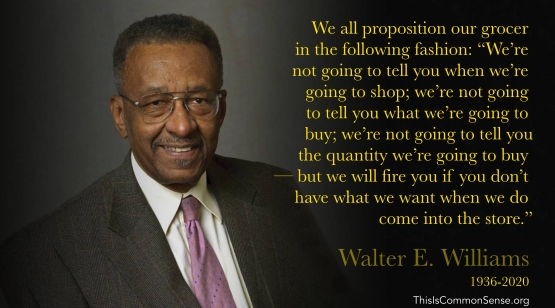
We all proposition our grocer in the following fashion: “We’re not going to tell you when we’re going to shop; we’re not going to tell you what we’re going to buy; we’re not going to tell you the quantity we’re going to buy — but we will fire you if you don’t have what we want when we do come into the store.”
Walter E. Williams (March 31, 1936 – December 2, 2020), Bradley Prize Winner 2017, was John M. Olin Professor of Economics at George Mason University.
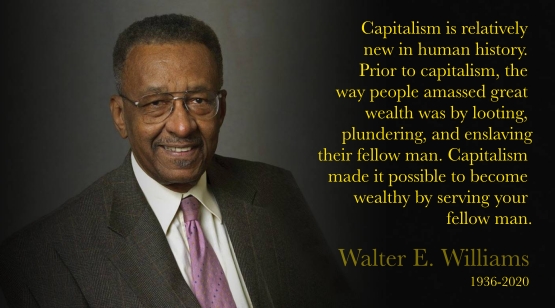
Capitalism is relatively new in human history. Prior to capitalism, the way people amassed great wealth was by looting, plundering, and enslaving their fellow man. Capitalism made it possible to become wealthy by serving your fellow man.
Walter E. Williams (born March 31, 1936), Bradley Prize Winner 2017, was Professor of Economics at George Mason University. He died on December 2, 2020.
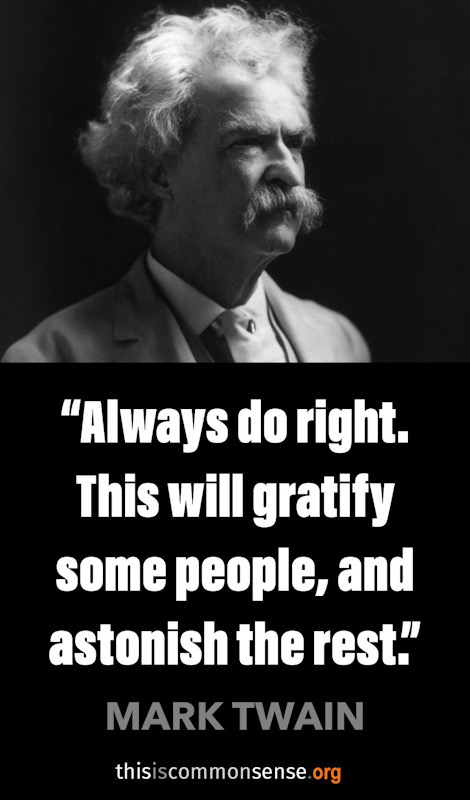
Always do right. This will gratify some people, and astonish the rest.
However deep you dig a well it affords no refuge in the time of flood.
Ernest Bramah, Kai Lung Unrolls His Mat, “The Story of Tong So, the Averter of Calamities” (1928).

Freedom, privileges, options must constantly be exercised, even at the risk of inconvenience. Otherwise they fall into desuetude and become unfashionable, unorthodox — finally irregulationary. Sometimes the person who insists upon his prerogatives seems shrill and contentious — but actually he performs a service for all. Freedom naturally should never become license; but regulation should never become restriction.
The character Amiante, in Jack Vance, Emphyrio (1969).
It is a mark of insincerity of purpose to spend one’s time in looking for the sacred Emperor in the low-class tea shops.
We’re not earning any money by ‘saving.’ The government is manipulating the economy for nobody’s good but its own. Republicans and Democrats both do this; probably Democrats do it for worse purposes than Republicans.
R.W. Bradford, “Why Don’t Americans Save?” Liberty (June 2005), pp. 23–25. In this essay, Bradford proposed a new statistical measure of economic life, the True Yield on Savings (TYS), with which he calculated, several years before the financial crisis of the late aughts, that, at that time, “you lose money when you save.”
But it’s about time that we all learned what’s going on. Call it a lesson in economic reality.
It is dangerous to be right in matters on which the established authorities are wrong.
Nothing is more powerful than individuals acting out of their own conscience.