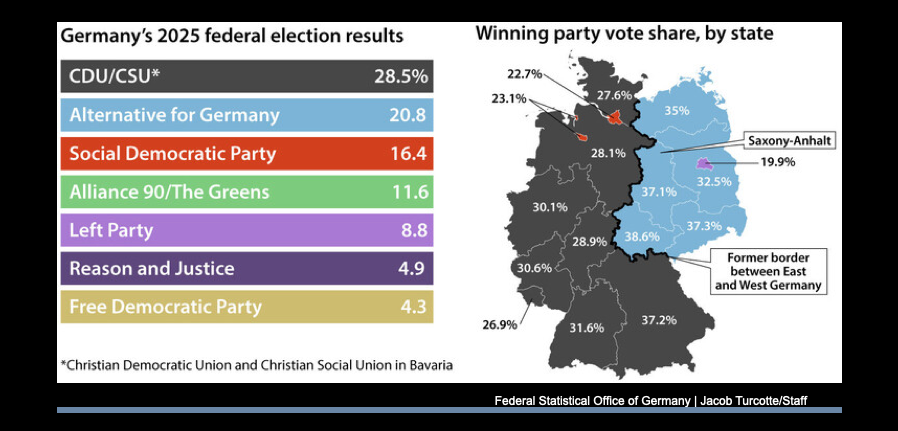
Today Germans vote, and the German government does not approve of how the votes in the former East Germany are likely to turn out.
The far-right Alternative for Germany (AfD), which has been declared extremist by the German government, will almost certainly win the most votes. It is polling at over 40%, with the closest party in the low 20s. In some scenarios, it could win an outright majority of seats.
It would be the first far-right party to control a German state since World War II. This matters not just because of the historical echoes, but because it would represent a dramatic failure of the postwar German order. German government, culture, and education have been carefully crafted in recent decades to prevent precisely this scenario.
Mark Sappenfield, ”Why one state election could rattle modern Germany,” The Christian Science Monitor (September 04, 2026).
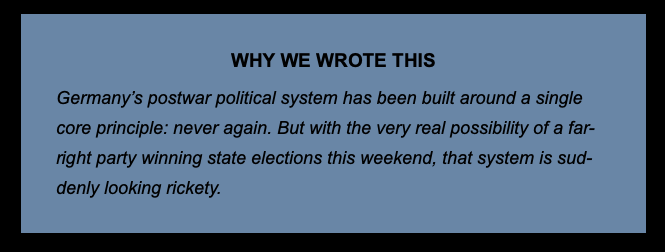
The Christian Science Monitor takes special pains to tell you why the election is important, and why it covers it in the manner it does:
The paper does understand that the AfD is not on board with the common characterization of it as being “far right,” much less fascistic and against democracy: “The AfD denies it is antidemocratic, but it relishes the idea of putting Germany on a new path.”
The party, it should be observed, calls itself an Alternative for Germany, not to the still-universally valorized democracy. Paul Jacob, in his coverage (see, for example, here), of the party, has noted that some of the government’s handling of the organization has itself been anti-democratic.
The fear is “nationalism,” a term variously used, but embarrassing for Germans because of the imperialistic nationalism of the Nazi period. According to the Christian Science Monitor:
At the AfD’s final preelection rally Thursday in the state capital, Magdeburg, a crowd of 6,000 is buzzing. For many Germans, flying the national flag brings a sense of discomfort — a fear of nationalism run amok. At the rally, German flags fly everywhere.
Is it worth noting that the United States, which in World War II sided with the totalitarian Soviet Union to defeat totalitarian Germany, did so as a nationalist enterprise with much waving of flags.
Perhaps there is more than one intention behind flag-waving.
At issue in this fascinating article is what it calls “remembrance culture,” the hyper-focus on Germans being bad because of Nazism. AfD supporters are less than thrilled about the pall this culture casts upon the country’s politics, and are amused by the “firewall” approach of all the other parties uniting against the AfD:
For Ronald Gläser, Saxony-Anhalt is just the beginning. The AfD member of parliament from Berlin sees the scales tipping — and the firewall is helping, in a way.
“The firewall made us the only real opposition in Germany,” he says. “Anyone who is upset turns to us.”
The question is whether the party is a threat to German democracy. Mr. Gläser rejects the charges against his party as an attempt to unfairly control the political discourse. “The AfD is just a party like all the others — more libertarian and more conservative, but not fascist,” he says.
The article can be read on Apple News, and on the paper’s own website.